One prompt, six hours, and a 2:50 film of my characters drawn entirely in code
I asked for an animated short of Jefrie, BloodTailor and Yusef with no image or video models. 27 Opus 5.5 agents wrote 24,000 lines of canvas code and came back six hours later with 2 minutes 50 seconds of it. The first passes were rough; review rounds on the rendered frames are what changed them.
On 26 September I wrote one prompt asking for an animated film of my three characters, and six hours later I had 2 minutes 50 seconds of it. Every frame is drawn by JavaScript on an HTML canvas, and the score and sound effects are synthesized in code. No image model, no video model, and no Blender.
The first pass of each chapter was rough. What made it better was a loop of fresh agents looking at the encoded video, frame by frame around every hit, and sending it back. Nothing in the code changed as much as what the reviewers saw.
Here it is. It’s violent: on-screen kills and blood, drawn in ink and red.
What I asked for
I’d seen a short on X by Alexey Fateev: six and a half minutes, all 9,363 frames drawn by canvas code Opus 5.5 wrote, in the style of Hedgehog in the Fog. He’d published the skill he used, and said the film came mostly from talking it through with Claude, in about two to three hours by his guess.
I didn’t want a children’s film. I wanted my own series: Jefrie at her iron-bar dome, the Storm Bell, killing whoever comes near it; BloodTailor walking through the unknown and fighting demons with blood magic; Yusef entering a betting fight in a foreign town, never getting hit, then drawing his sword with his third arm while the other two still hold his lantern and his Bible. The characters were never to share a scene. Between them, a pop-up book: the current character’s cut-out on the left page, the next one’s rising on the right, and the camera flying over to it.
And I told it not to use that skill. The prompt said to build its own engine for this style, “focuses on being able to illustrate the blood, mud, metal, and impact frames”, and that “attacks should have leading lines with acceleration curves so attacks feel heavy and impactful.”
I asked for it to run in the cloud. The session launched it as a remote agent and called it “the cloud agent” the whole way through, but its first command cloned the repo into a temp folder on my laptop, and that’s where it ran.
How it was built
The times are from the session transcript and the film repo’s git log, Central time.
- 14:39. My prompt. Three agents turn my reference images into a drawing spec per character, and a second pass checks each spec against the canon on my Notion pages. Where an image disagreed with the canon, the canon won.
- 14:48. One Opus 5.5 agent gets the brief, the specs and 13 reference images, with no videos. By 14:58 it has committed the engine core: easing and strike curves, hit-stop timing, ink brushes, springs and chains, camera shake, blood, mud and metal.
- 15:02. It starts eight builders in parallel: a rig and model sheet for each of the three characters, the strangers, demons and gore, two environment builders, the pop-up book, and the audio.
- 16:30 to 20:10. Chapters built hero shot first, then three rounds of review on the encoded MP4s, with a fourth for chapters 2 and 3. The reviewers were fresh agents each round.
- 20:46. The final commit: the film, 31 shots, 4,095 frames at 1080p and 24 fps.
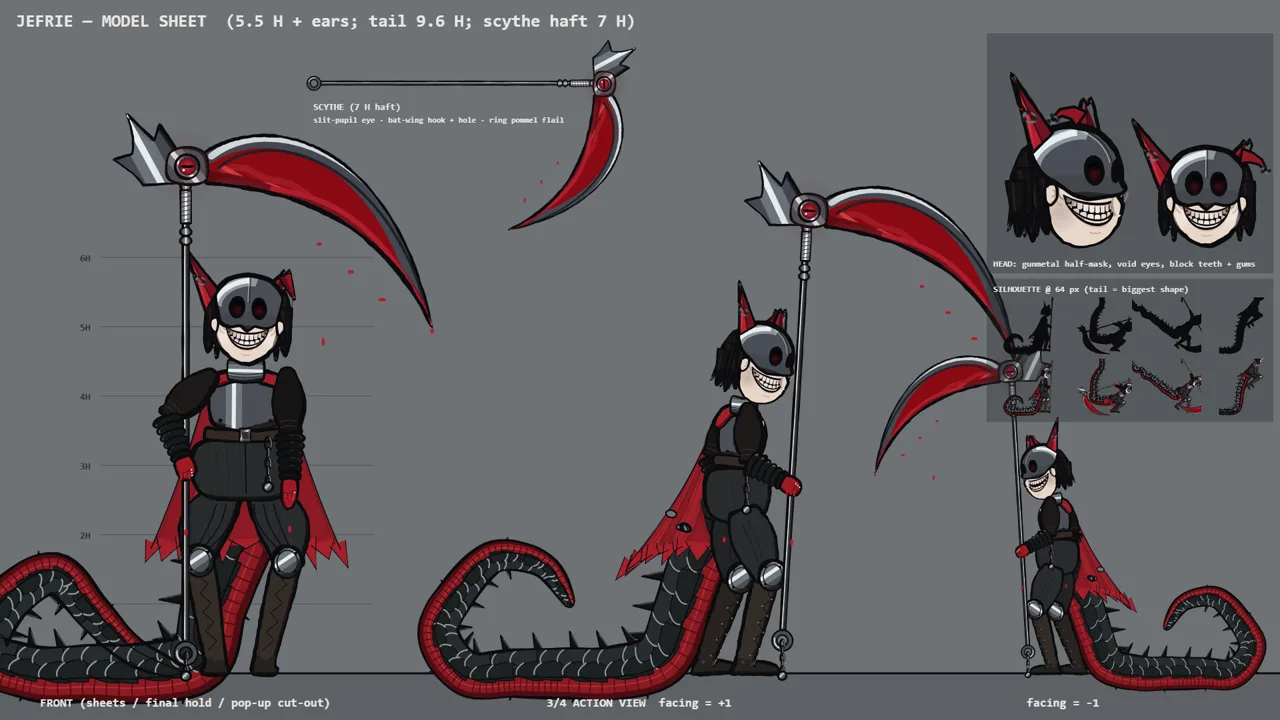
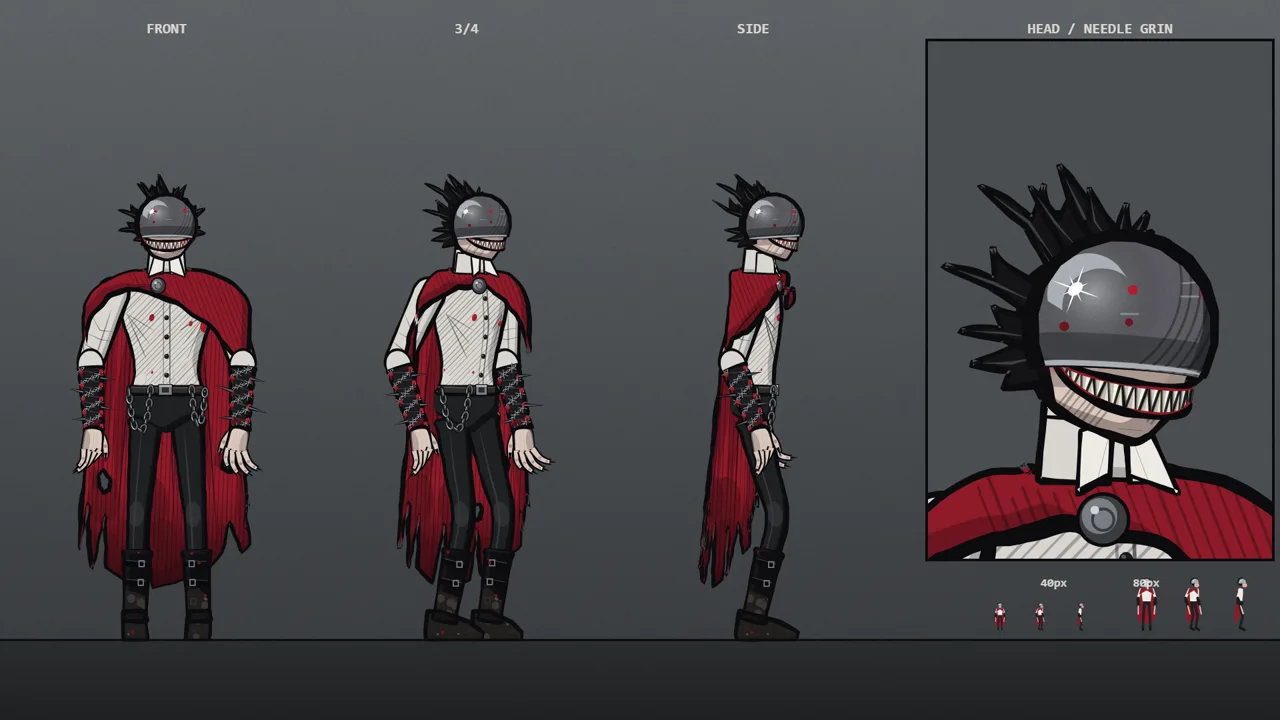
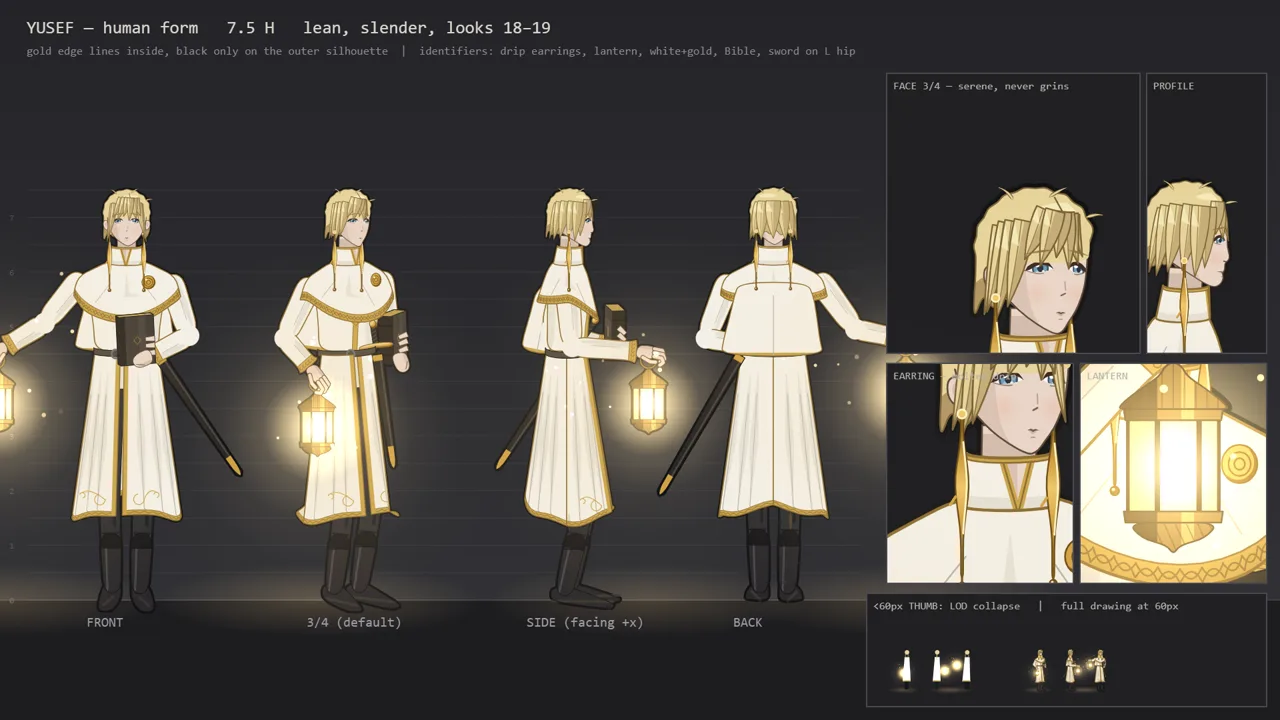
The model sheets came first, and the characters weren’t animated until those matched the specs. These are the finished sheets, rendered by the same code as the film.
First pass and last
The pop-up book was one of the first things built, before the characters existed. The left video is that first test at 15:36, with placeholder cut-outs: that Jefrie is the one the notes say “read as a skull”. The right is round three at 20:13. Both are 9.5 seconds and play together.
In the final version the book opens on the exact last frame of Jefrie’s chapter and hands over on the exact first frame of BloodTailor’s. The agent measured both seams at about 41 dB PSNR.
The characters went the same way. Each rig got a motion test on a grey stage before any shot was built. On the left, those tests at about 15:45. On the right, the shots they became.
The frames that make a hit
At full speed a hit goes by in a quarter of a second, and the parts that make it land are single frames. So these two shots have frame controls: step through them, or jump to the marked frames.
In Jefrie’s kill, frames 44 and 45 are the smear of the scythe coming down. 46 is a silhouette frame, black on bone. 47 is the red frame. 48 to 51 hold on the contact with radial lines while the camera keeps shaking, and only then does the blood go.
Yusef’s gets two impact frames: a silhouette at 32 when the maul lands where he was standing, and red at 48 when his blade lands. The brief allowed him gold as the one other colour, and it stays on in the red frame.
The reviewers’ notes are what taught the engine this. A downswing hidden inside the white frame “reads as nothing”, so there must be two or three visible smear frames before it. Contact is computed from the blade edge, not set on a fixed frame. A character hanging at the top of a jump before striking kills the momentum. For Yusef, who must never be touched, the last round measured the gap between his silhouette and the fighter’s on every frame.
What it says is still wrong
The film’s notes end with the agent’s own list:
- The drawing. The characters are rigs built in code. They read on-model at film size, but they’re stiffer and flatter than hand-drawn keys, and hands, faces in motion and three-quarter turns are the weakest. The strangers and the pit fighter look “a bit paper-doll”.
- Two faked angles. In two BloodTailor shots, a reverse angle was made by mirroring a side-view rig, and his screen direction flips with no bridging shot.
- Blood. Some of it still reads as particles, not liquid.
- The last kill. The fighter’s lower half stays kneeling instead of falling.
- The sound. “Audio was never listened to by a human in production.” It was checked by measurement only: loudness at −16 LUFS, peaks at −1 dBTP, a click detector. The crowd voices are what the agent expects to sound most synthetic.
The last pass also caught 16 blank frames that had come from Chrome losing its GPU canvas while shots rendered in parallel. It now renders with the GPU switched off and a guard that retries any shot with a blank frame. That was in the assembled film, which is the only place it could have been found.
What it cost
27 agents, all Opus 5.5, over about six hours of wall-clock. 2,091 requests, 467,000 output tokens, and $291 at API list prices, which I don’t pay (I’m on a flat subscription). The repo holds 24,085 lines of JavaScript: 5,029 of engine, 18,725 of film and 331 of tools, in 23 commits. The engine is also written up as a skill with eight reference files, so the next film in this style starts from it.
AO-020 was the same method at a smaller size: one agent, one file, 30 seconds of Clawd, and a score nobody listened to before it shipped. Here the agents did look, over and over, at every frame that mattered, and the one thing nobody looked at was the one thing a frame can’t show.