Twelve days of AI films on an 8 GB laptop: everything I tried, and how each one turned out
Between September 23rd and October 4th my laptop made a 13-minute Jefrie saga, an 8-minute Echo film, a monster fight, three versions of a music video and a song video that I still call subpar. About 36 GPU-hours of MiniMax-H3. Here is every method, what it got right, and the failure each one taught me.
Today I cleaned out my films folder. My drive had filled up again, and the folder was twenty-odd gigabytes of saved latents, frame dumps, retakes and previs renders sitting next to the handful of films they produced. Before deleting any of it I had Claude go through every project and write down what we tried, why, and how it turned out, because the intermediate files are where the lessons were.
This is that write-up. It covers twelve days, September 23rd to October 4th: about 36 hours of GPU time, almost all of it MiniMax-H3 running locally on an 8 GB RTX 4070 laptop. Some of it I’m proud of. Some of it I’ve called “extremely subpar.” Both kinds are in here.
The one trick everything is built on
MiniMax-H3 makes about six seconds of video with sound per generation. That’s the ceiling for one clip. What made everything else possible was a ComfyUI pack by SatoDive that saves the clip’s latent (the model’s internal version of the video) and lets the next generation continue from it. Each new segment takes the last second of the previous one as its starting context, then carries on. Joined frame-exact, the seams are invisible and the ambient sound runs straight across them.
So a long film is a chain of six-second links. That’s also the catch, and most of this post is about it: the chain carries everything forward, including its mistakes.
Jefrie: one film that grew to 13 minutes
It started with a two-minute film of Jefrie reading on the sandbags at dusk. Then I asked for a continuous two-minute shot continuing from it: she closes the book, walks off, vaults a barbed-wire fence, climbs a building, jumps off the roof and ends at a lookout.
It worked, and it’s two unbroken minutes of one camera. But around segment 9 she started turning into a toy. The reference image I’d given was a studio-grey render of her, and the chain picked up a glossy, plastic 3D look and her white full-face mask came back. Claude retook segments 9 to 11 with a painted reference. It didn’t help at all:
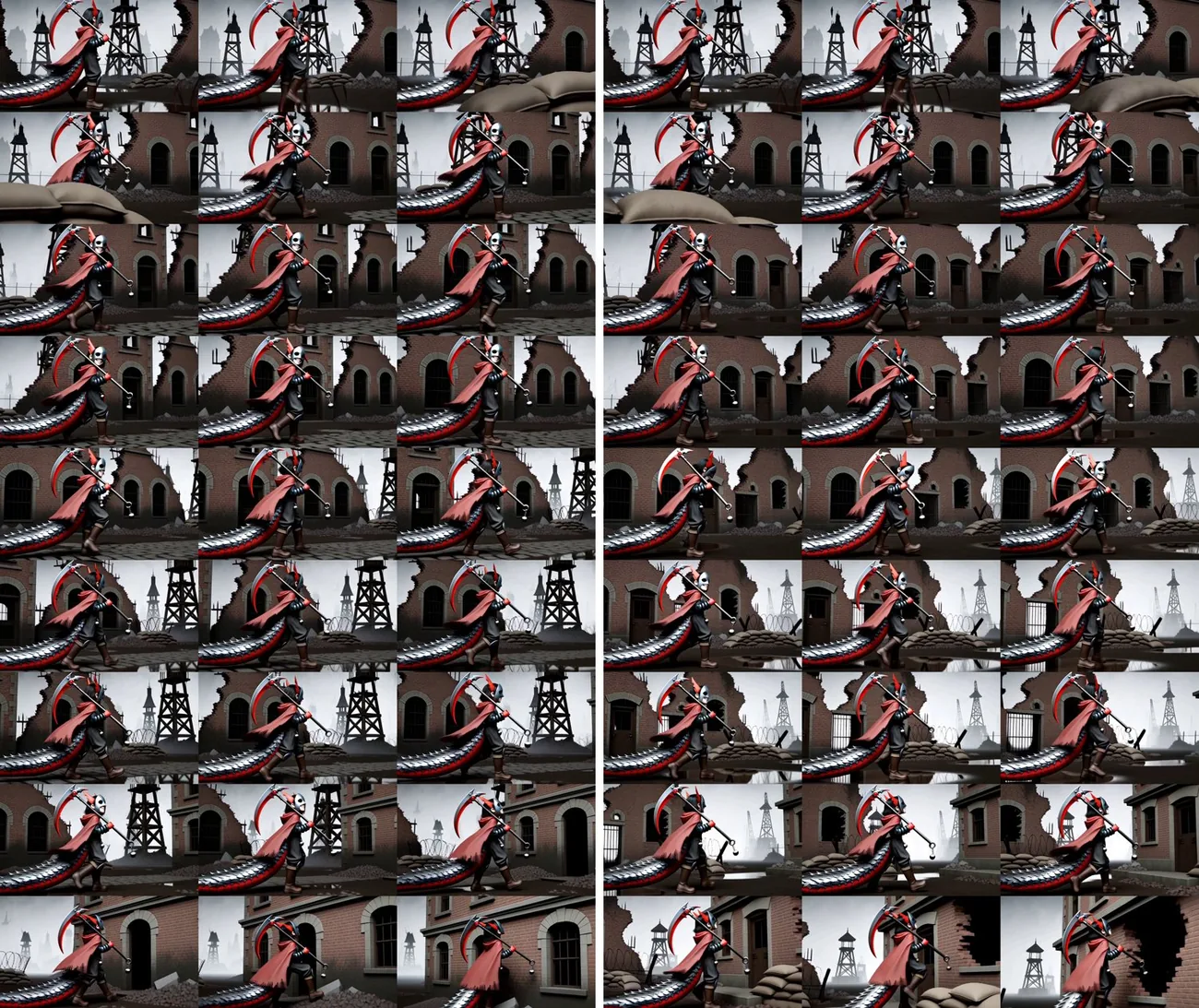
That was the first big lesson. Once a chain has drifted, a better reference can’t pull it back. The style lives in the latent now.
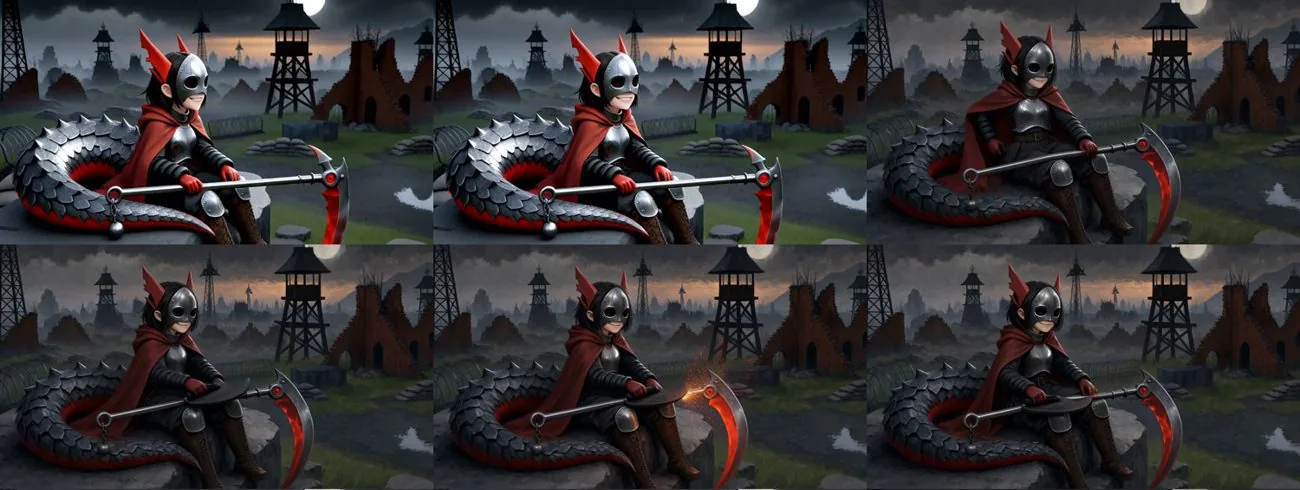
What did pull it back was end frames. For the next piece, a 16-second “she sharpens her scythe, then a close-up of her face,” every segment got a painted still (made with Qwen-Image 2.1) as the frame it had to land on. The first segment starts on the toy look inherited from the stroll and is painted again by the end of the clip:
Then I asked Claude to queue up a night’s worth of work by itself: five more minutes, with a Qwen end frame for every segment, built up front as a storyboard I could review. That became the 5-minute night film, 61 segments. I loved it, and I told it so. But we used end frames too often, and sometimes we used one that was a bad image generation. Two of the tail close-ups came from Qwen images where her tail wasn’t attached to her body, and H3 faithfully animated a detached tail. And the stretches where H3 was left alone, sitting on the ledge with the cuts around her, were some of the best coverage in the film. It’s actually good at picking shots when you let it.
There were smaller lessons that night too, all of the same kind: words summon things. “Warm lantern or spark light” put a campfire on the lookout. “Thunder” in the audio prompt made lightning flash in the picture. Naming the dome in the film-wide description teleported her into it in the first test.
The last piece was four minutes of her training, with the camera free to move around the yard. The first try used only 9 end frames out of 48, and H3 fell straight back into its default smooth 3D-CGI look at the very first cut: green lawn, pink cape, near daylight. What balanced it was an end frame about every three segments in the action stretches and every five or six in the calm ones, plus a painted picture of her inside the scene as the reference instead of a character sheet on grey.
That film also has my favourite H3 generation so far, segment 42, the finishing sweep:
About a second and a half of stillness, then an explosive two-second swing, then a settle. One idea in the clip, a steady camera, an end frame at the exact end of the move. The motion streaks came from asking for a “pale moonlit streak” and getting anime smear arcs, which I’ll take.
All five pieces join into one 13-minute-16-second film, made six seconds at a time on a laptop. It took about 14 GPU-hours.
Echo: a character Claude designed for itself
On the 25th I asked Claude to design its own character for my world, with me picking between four options at every step. It came up with Echo: a porcelain bell-headed former mouthpiece of the Devil who has no voice of its own and keeps dead soldiers’ last words as porcelain face-beads. It made four one-minute films over two rounds (the whole story of that is here), and I loved them enough that I gave it the GPU for a whole night.
What it did with the night was an 8-minute, 101-segment film in eight chapters that ties all four shorts into one story. It’s the first time a film that long held the painted look the whole way through:
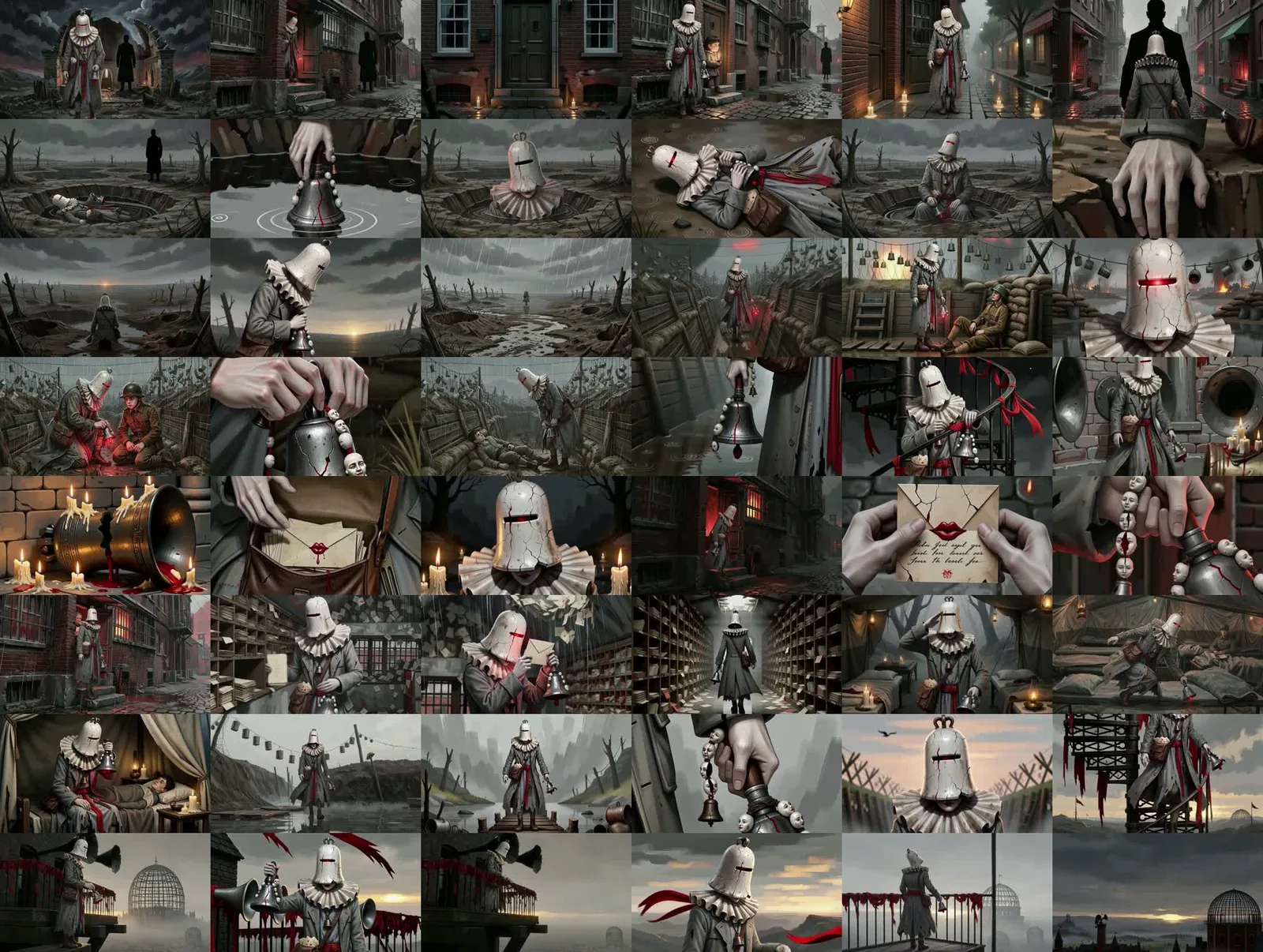
Thirty seconds of it, from the trench chapter:
The Echo films taught their own lessons:
- What’s under the keyframe matters as much as the prompt. Two films used the same method. One had keyframes painted over a photoreal plate, and every face in it drifted into Pixar: a big-eyed CG boy on a cot. The other used a painterly plate and held. Same with Jefrie’s grey studio reference becoming a toy.
- Side characters drift first. In the 8-minute film Echo stayed painted, because it was anchored everywhere, but the child and the soldiers in close-up drifted toward photoreal. Each needed its own painted end frame and a retake.
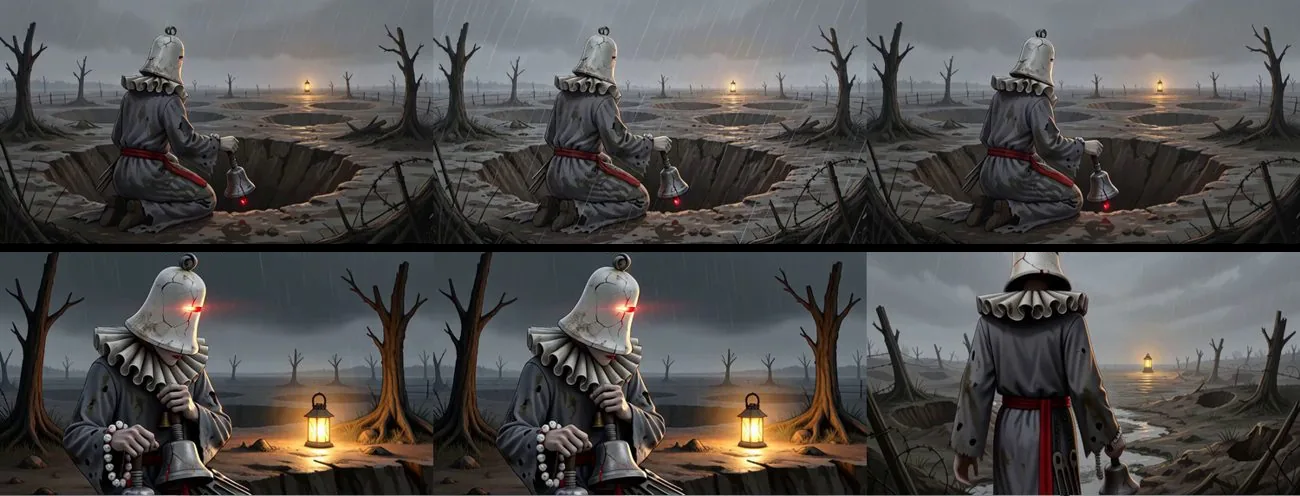
- Distance isn’t respected. A lantern described as “far away on the horizon” walked up and sat next to Echo:
- Colour carries meaning you didn’t ask for. Red candle wax on a split bell read as blood, and five segments had to be redone with ivory wax.
- A pose sheet as a reference makes two of the character. Six poses in, two Echos out, one of them headless.
And one I still find funny: the speech check uses Whisper to make sure no voices slipped into the ambient audio. On rain and birdsong it confidently hears “thank you for watching, please subscribe and hit the bell icon.” That means there’s no speech.
BloodTailor: two tutorials, one finished
Two experiments came from following other people’s tutorials step by step.
The first was Higgsfield’s own Blender-plus-AI breakdown: asset sheets, a storyboard, grey-geometry Blender previs for the hardest shots, a five-block prompt per shot. Claude followed it and made “The Hollows at the Storm Bell,” a 72-second fight with BloodTailor and Jefrie against mud monsters. The grey previs as a video reference worked. H3 kept the blocking, timing and camera move and took the look from the images:
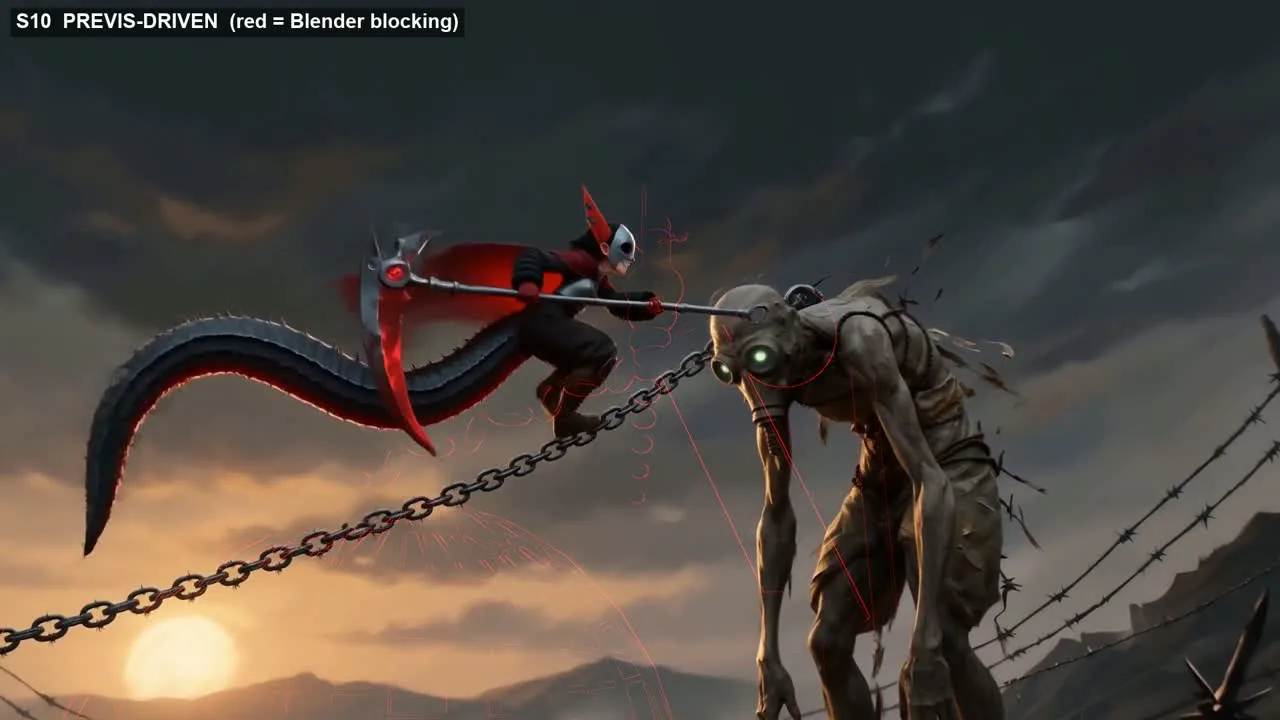
I liked it. But almost all of it ran on Higgsfield’s cloud, and I’d wanted it done locally. Only one shot was ever re-rendered on my GPU. It also came out glossy 3D even though every prompt said “hand-painted, not 3D.” And it’s where I first saw a failure that kept coming back: name a character in a shot without giving their reference, and H3 invents someone. A BloodTailor-only shot got a hybrid companion.
The second tutorial was five 30-second experiments for BloodTailor, all local: a corridor one-take, a dialogue scene at a table, camera moves, a blood-magic “commercial,” a rooftop chase. All five previs got built in Blender. Only the first block was ever rendered:
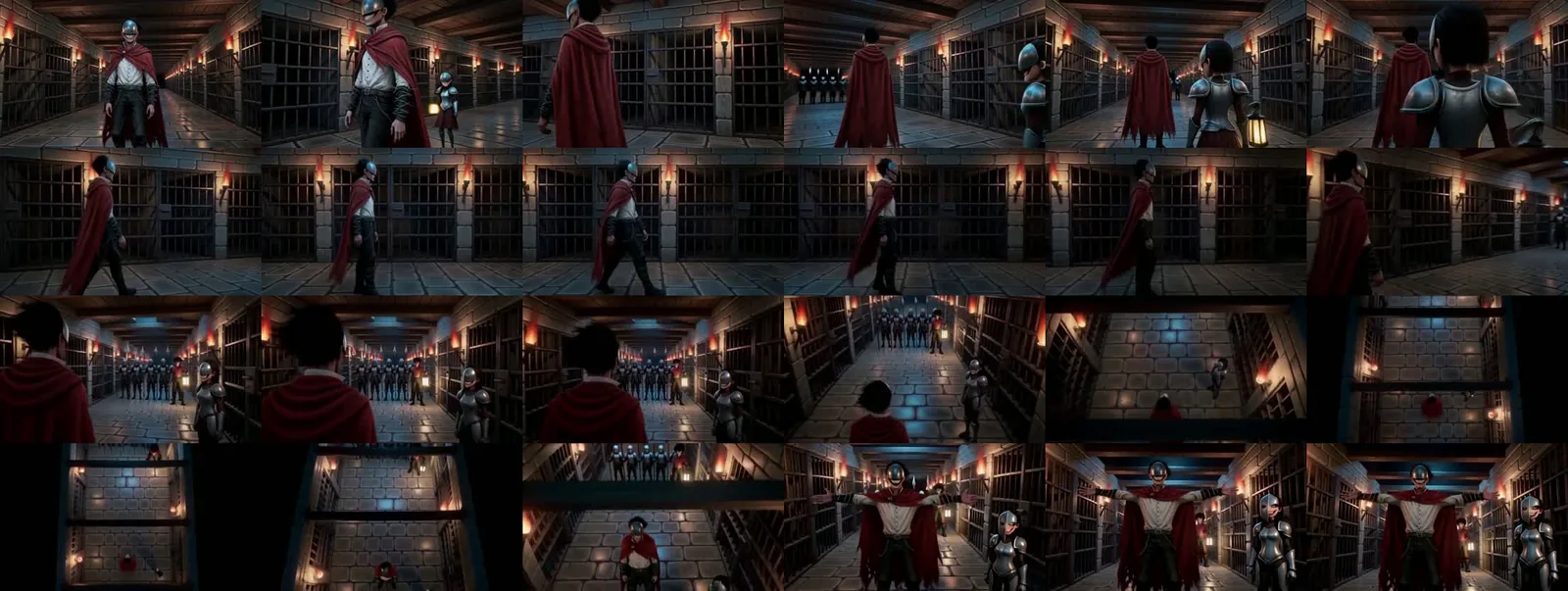
The first clip took 49 minutes instead of 5. The GPU sat at 100% while drawing about 37 watts, meaning the model was being paged in and out of memory because other sessions had left their models loaded. Freeing memory first brought the clips back to about ten minutes. Then the dialogue scene, with four or five reference images plus the previs, overflowed the 8 GB card completely and projected over an hour and a half per clip. That project was abandoned, and it left a rule in my notes: with a previs, two image references at most.
BLACKWATER “Still on Shift”: three versions in eight days
“Still on Shift” is the jukebox song from my cave-diving zombie game. Its music video got made three times, each time with a different main pipeline.
v1 rendered inside the game itself, no AI video model at all. Claude wrote a director script that ran in Godot, staged 35 shots with the game’s caves and crew, and cut them to the song. My notes on it: zombies swam into the lens, the camera shook violently, the guide line was far too white, and the captions made it feel more like an ad than a music video.
So for v2 we tried local H3, starting with a 30-second test that repainted the game footage into photoreal:
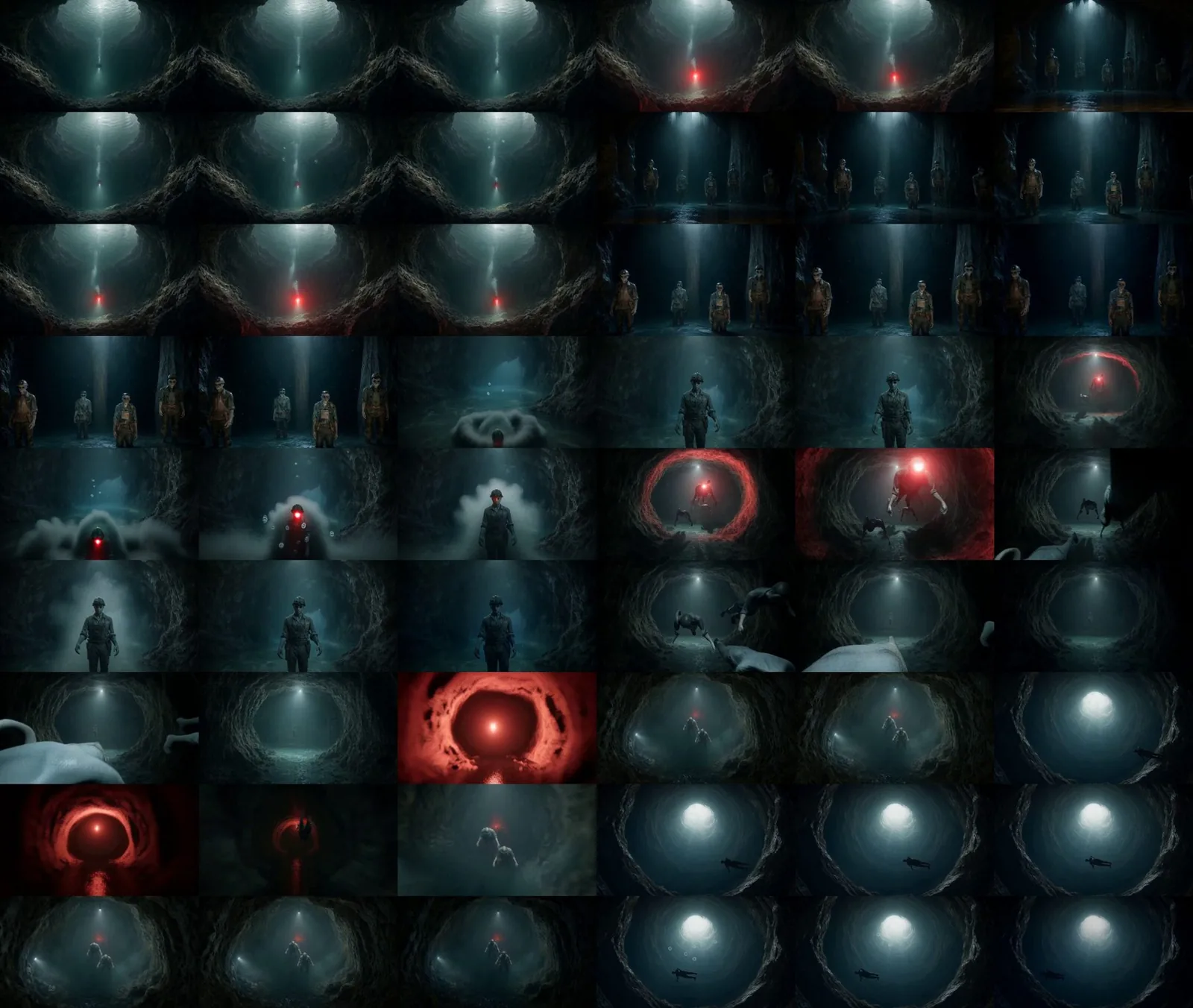
It was very good, but it was adhering too much to the previs. The fix was to replace the game’s zombies with grey capsules in the previs and tell H3 they were placeholders to be animated freely. That worked, and the men started to sway and reach. The full v2 then had to be restarted twice: first because every cut landed three or four seconds late and empty shots filled up with invented mannequins (the film-wide text said “replace every block with a miner,” so it did, everywhere), and then because the look drifted back into game graphics until every segment got a painted end frame:
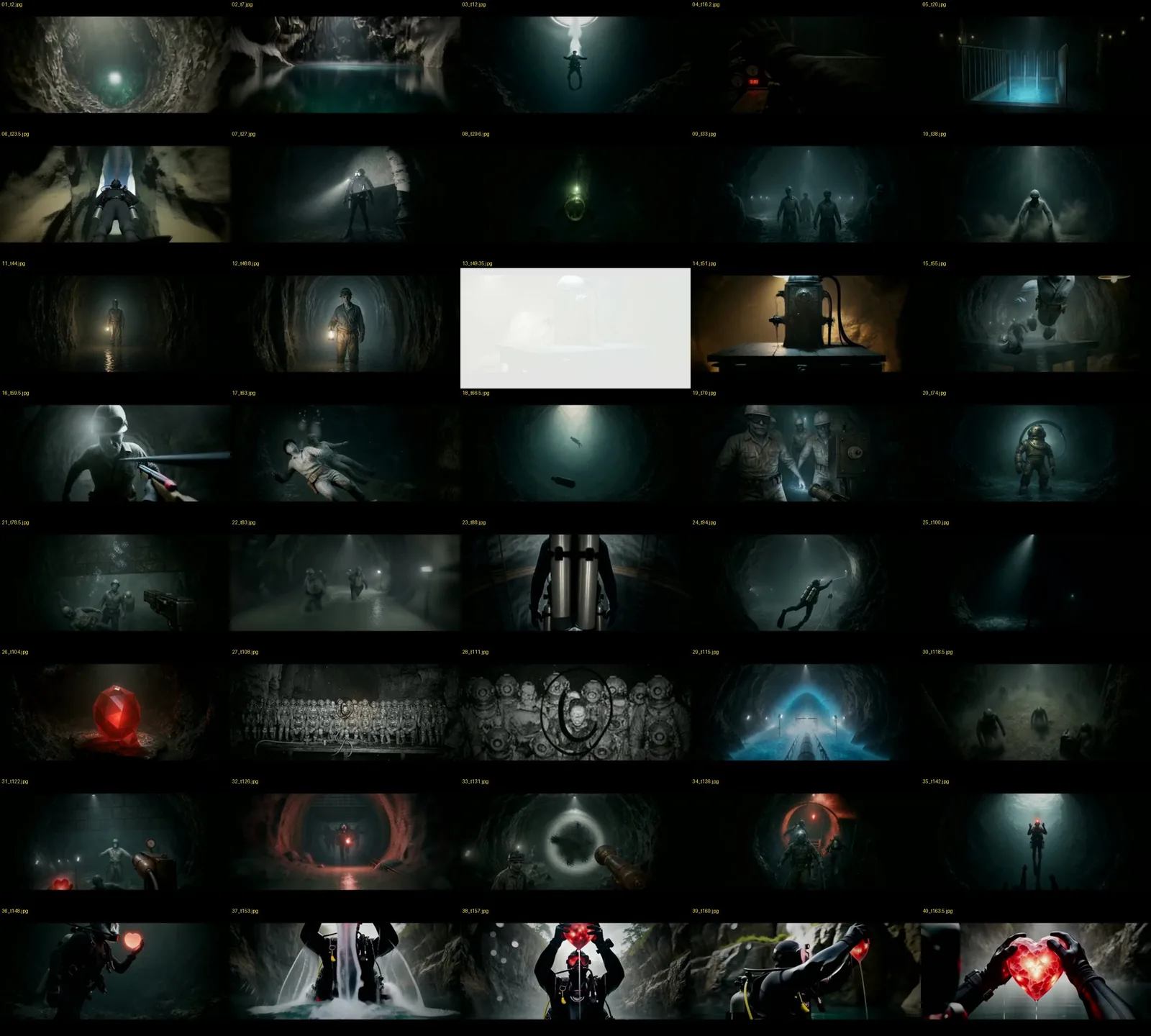
The best shot in v2 was the ending, which I’d asked to be done with no previs at all: an up-close, dynamic 14 seconds of the diver bursting out of the water with the heart, straight to video at 1344×768. It was the shot that convinced us a static previs was holding everything else back.
v3 started over from the song and the lore instead of the game: the full four minutes, 97 shots, Qwen-Image keyframes, H3 at 1344×768, words written into the world on ledgers and stencils instead of captions, and an edit locked to the beat. Twenty-five seconds:
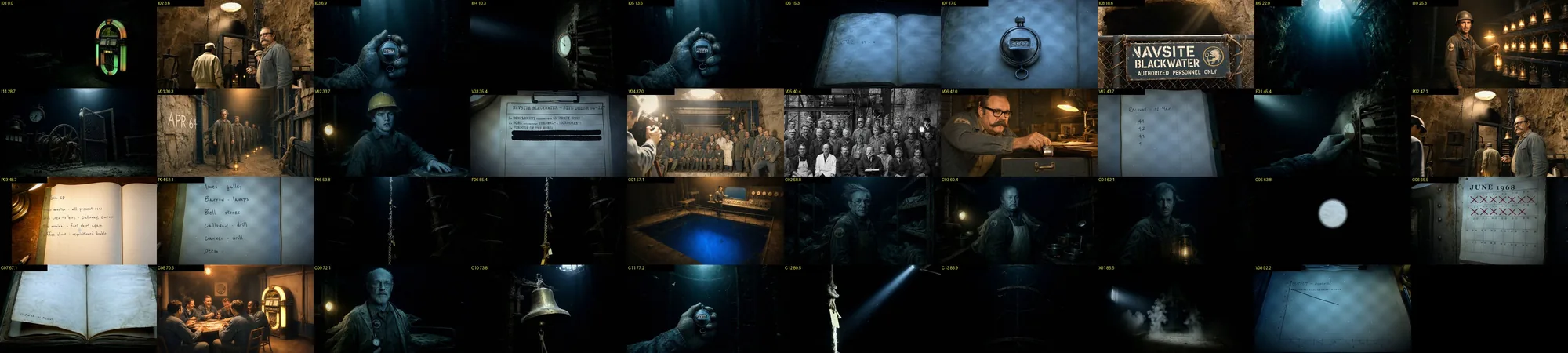
Its failures were new ones. Silt described as a “cloud” rose as bright opaque cotton. A drowned stove grew flames. Counter digits came out wrong, so exact numbers went in as code overlays. Qwen kept adding a fish no matter how many times we said “no fish.” Two actions in one clip went wild every time, so the rule became one action per clip, landed on the right word in the edit by changing the clip’s speed, not in the prompt.
Moonlight at the Waterline: still not there
The other BLACKWATER song got the whole-song H3 treatment too: 2 minutes 51, 33 chained segments, about three GPU-hours, driven by grey renders from the game. The new thing here was timing. Over a whole song, H3’s cuts drifted between 6 frames late and 45 frames early against the bar lines, so Claude found each real cut and stretched each shot onto its bar:
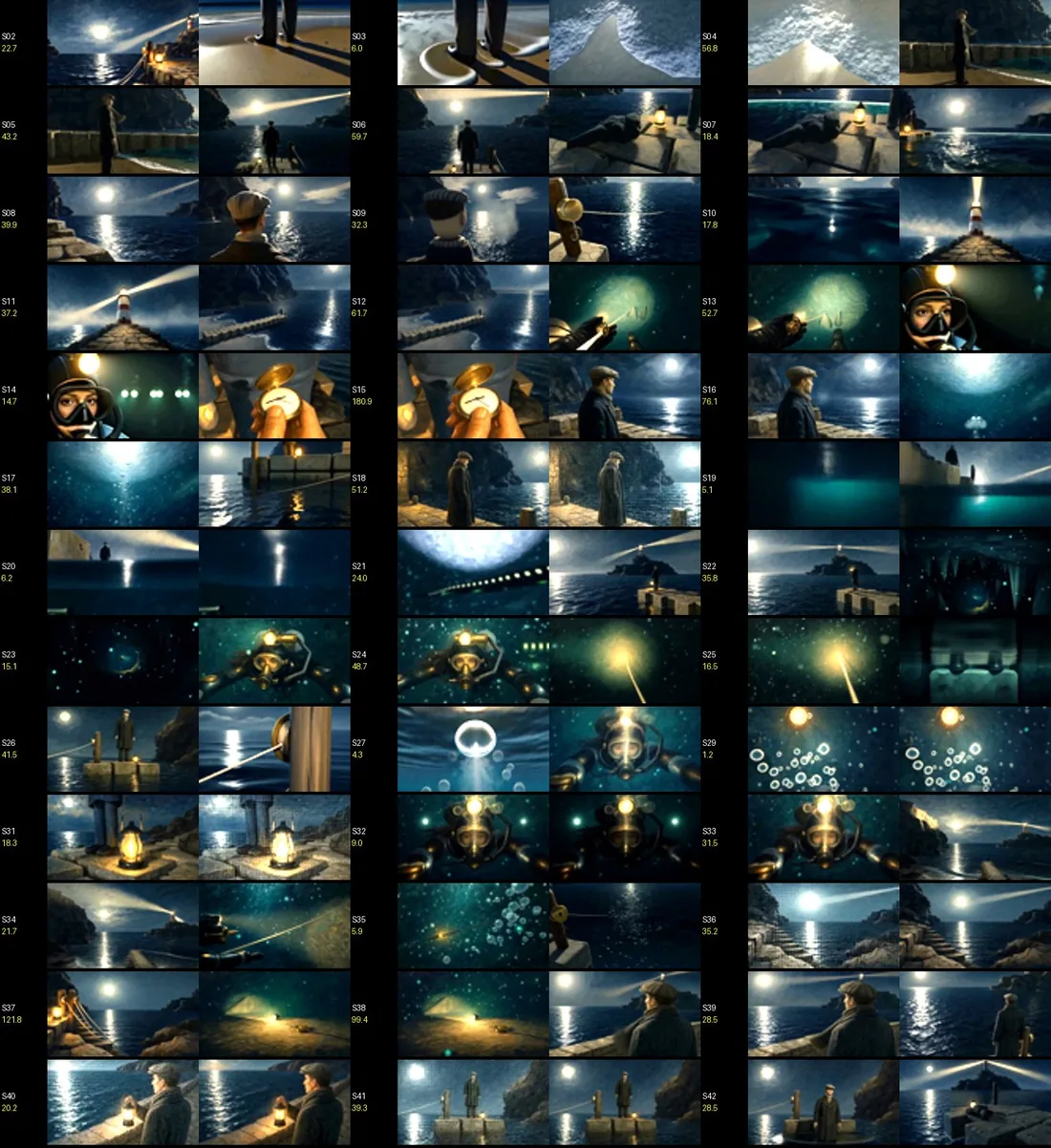
It came out better than the version before it, and I still said it was extremely subpar. The lyrics pasted on top were hard to read, every shot was exactly one bar long, the same composition kept repeating, and it was 736×416. It’s moved on since: a version drawn entirely in code, and a v4 that’s still in progress.
What held across all of it
- Latent chaining works. Thirteen minutes of one character, six seconds at a time, on a laptop, with invisible seams.
- The chain remembers style. Drift can’t be fixed after the fact. Anchor it before, with painted end frames.
- End frames are a dial, not a switch. None and it falls back to CGI. On every segment, bad keyframes get copied and H3 stops choosing its own shots. Every three segments in action and five or six in calm worked.
- The models copy what you show them. Qwen copies the reference pose. A photoreal plate gives Pixar faces. A coloured previs gets copied as a look. A bad previs gets copied as bad motion.
- Words summon things. Name a person and they appear. “Lantern light” is a campfire, “thunder” is lightning, “cloud” is cotton, red wax is blood.
- A previs gives you space, camera and cut timing, and caps the motion. Make one only if its motion is better than what the model would make up.
- Never trust generated text or numbers. Put them in afterwards.
- On 8 GB, the card is the budget. Free memory before every clip, two references with a previs, and if it’s pegged at 100% on 37 watts, stop it.
The one that matters most to me isn’t technical, though. Every big jump in quality came from my notes, not from a setting: no captions, no camera snaps, never show the heart, the Lamp Man for half a second and no more. The pipeline got better each time, but it got better in the direction I pointed it. Twelve days in, the films aren’t good because the model is good. They’re as good as the notes I gave it.