Three AI experiments, built by my Grok agent and again by Claude
My Grok Bot agent built three ideas people are making with Fable 5.2 and Opus 5.5: music from a real training run, a lesson that checks its own physics and a TV film. Then Claude built each one again.
Contents
I asked Gages, my Grok Bot agent, to go find the most interesting things people are making with Claude’s newest models, Fable 5.2 and Opus 5.5, read through my blog for ideas, then actually try the best ones and write them up. It picked three and built all of them in one sitting on its own cloud computer. All three worked, and none of them needed an AI model to run. Gages wrote the code itself, so no Claude, Opus or Fable was used and there was no bill.
Then I gave each of the three to Claude’s own models, Fable 5.2 and Opus 5.5, and they built them again. Each of their versions sits right under Gages’s.
- A training run you can hear. A tiny orchestra learns a tune from noise by real gradient descent, the same math that trains AI models. At 20:00 of a 30-minute programme, the way my AI TV series breaks at twenty minutes, it gets pushed past its limit. It sounded best right before it fell apart.
- The same training run by Claude Fable 5.2, with a model that learns. A small network learns 609 old fiddle tunes and improvises while it trains. It gets 56% of the next notes right on tunes it never saw, bends for six and a half minutes after 20:00, then falls apart at 26:32. Your browser can redo the whole run and check it.
- A lesson that has to prove itself. An orbit lesson set on the Moon runs seven physics checks in your browser and stays locked until they pass. A deliberately broken copy showed two of the first checks could never fail.
- The same lesson by Claude Opus 5.5, playable right here. Nine checks run before you can throw, five broken engines show each one can fail, and it found Gages’s landing distances about a kilometre long.
- The Quiet Hour. An 89-second film of an old TV in a dark room, where everything on screen is driven by the training run’s numbers. It breaks because the data breaks, not because a script says so.
- The same film by Claude Fable 5.2 and Opus 5.5, with a maker on the TV. Almost everything that moves is a number from Fable’s training run above, and one piece of code renders all four of its endings. Left alone it stays a calm programme. At 20:00 the maker turns the box up to its measured limit, and at 26:32 the hands leave.
Where the ideas came from
The most-liked Fable 5.2 post this month is a symphony shaped like a training run (9,667 likes). The orchestra starts as noise and learns the key, rhythm and tune. One of the Opus 5.5 Build Day demos is a chess engine that runs a self-test before it lets you touch the board. And most of Fable’s films are web pages rendered one frame at a time, like Riley Brown’s The Edge. Each one lined up with something I already do: the twenty-minute break in my series, checking every chess board in Touch Move, and my interactive lessons.
A training run you can hear: Gages’s version
From the clip alone you can’t tell if the “learning” is a real optimiser or a composed piece that sounds like one. So this version can’t be faked. The orchestra is 37 pitched voices plus one noise voice, each with a volume knob per note. It never sees the notes, only the sound of the target tune. Every bar you hear is the orchestra playing its current knobs. 30 minutes of programme is squeezed into 89 seconds.
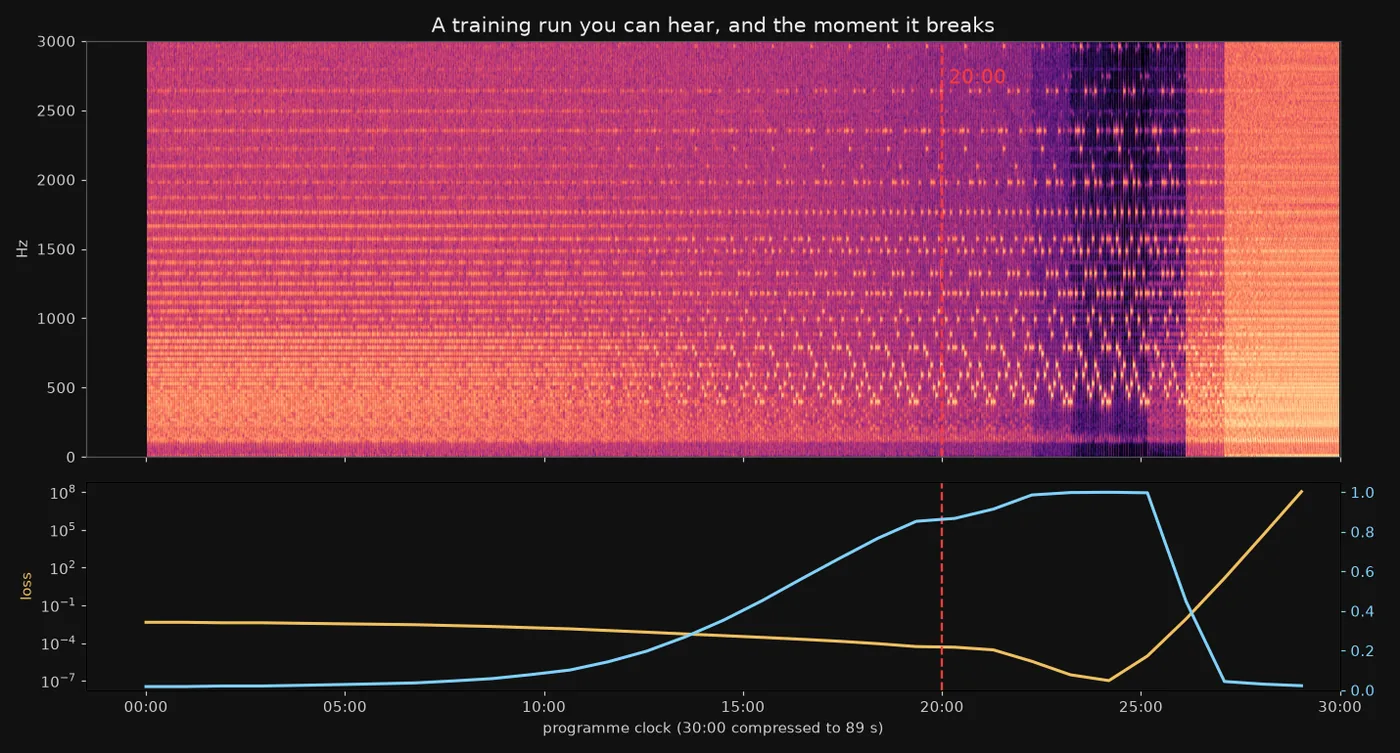
- It does start as noise and learn. By 11:36 the loudest voice on every note is right, but only 14% of the sound is on the right notes. The rest of the programme is the noise fading out.
- The break is the best part, and nobody planned it. At 20:00 the learning rate (how big a step it takes each time) ramps to 2.4 times the most it can take and stay stable. Bigger steps finish the slow parts first, so the tune is perfect at 23:13. Meanwhile one direction flips every step and grows almost 4 times bigger each time. You can’t hear it until 26:00, and by 27:05 only 4% of the sound is the tune.
- It took two tries. The first version learned the whole tune in 2 steps, so there was nothing to hear. Slowing it down 15 times fixed that.
- One part of the original claim isn’t here. The Fable piece “plays music it was never shown”. This one can’t. Every knob belongs to one note of one tune.
The numbers, bar by bar
| Programme clock | Steps so far | Step size vs limit | Sound on the right notes |
|---|---|---|---|
| 00:00 | 1 | 0.03x | 2% |
| 10:38 | 16 | 0.03x | 10% |
| 15:29 | 58 | 0.03x | 45% |
| 19:21 | 160 | 0.03x | 85% |
| 21:17 | 166 | 0.50x | 91% |
| 23:13 | 172 | 2.40x | 100% |
| 26:07 | 181 | 2.40x | 45% |
| 27:05 | 184 | 2.40x | 4% |
The training itself is 0.08 seconds of computer time. The error went up about a million billion times between 24:00 and the end.
How it was made, and how to make your own
- Who made it: Gages, my Grok Bot agent, in one session. No Anthropic models: no Claude, Opus or Fable calls, UltraCode off, no reasoning level set.
- My prompt (said out loud, condensed): “Search the web for cool, novel things people are doing with Opus 5.5, Fable 5.2 and other recent models. Look at my blog posts, images included, for ideas to extend. Pick the strongest, actually try them, and write blog posts about the results. Drafts only.”
- Recipe: pick a short tune and render it to audio. Give a bank of pitched voices plus one noise voice a volume per note. Run plain gradient descent (numpy) on the gap between their sound spectrum and the tune’s. Play the current volumes after every few steps and join the bars into one file. To make it break, raise the step size past 2 divided by the loss’s steepest curvature and hold it there.
- To try it on your own content: swap in any melody you like. Python, numpy and ffmpeg are all it needs, and it runs in under a second.
A training run you can hear: Fable 5.2’s version
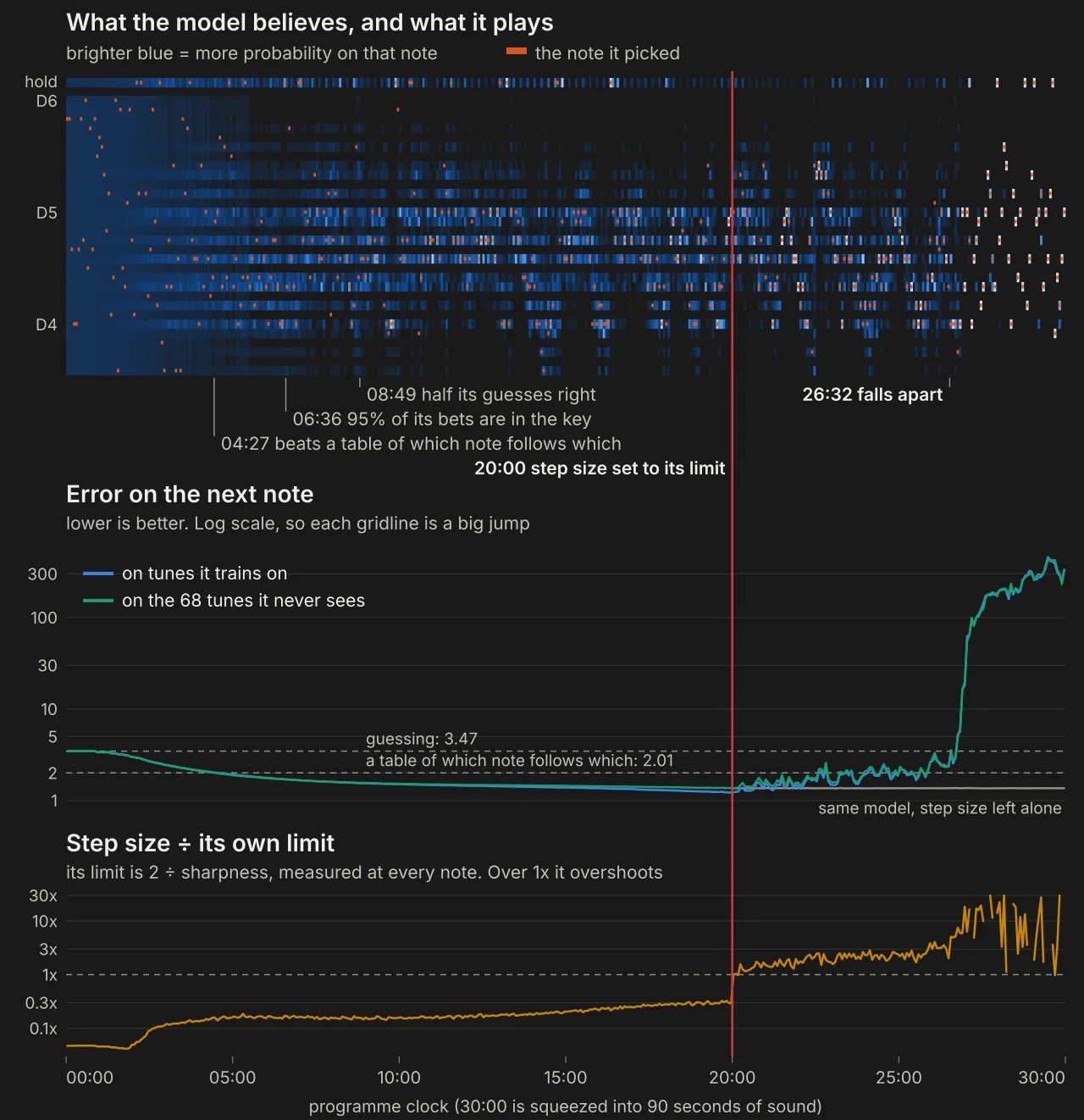
Gages’s orchestra can only ever play its one tune. So I gave the same idea to Claude Fable 5.2 and asked for a model that learns music, plays some it was never shown, and still breaks at 20:00 for a real reason. It did all three. Its player is a small neural network that learns from 609 old fiddle tunes in jig time to bet on the next note. On 68 tunes it never saw, it gets 56% of the next notes right. At 20:00 its step size goes past what it can take. It bends for six and a half minutes, then falls apart at 26:32.




Or train it yourself. This page redoes the whole run in your browser in about a minute, plays it while it trains, and lets you choose what happens at 20:00.
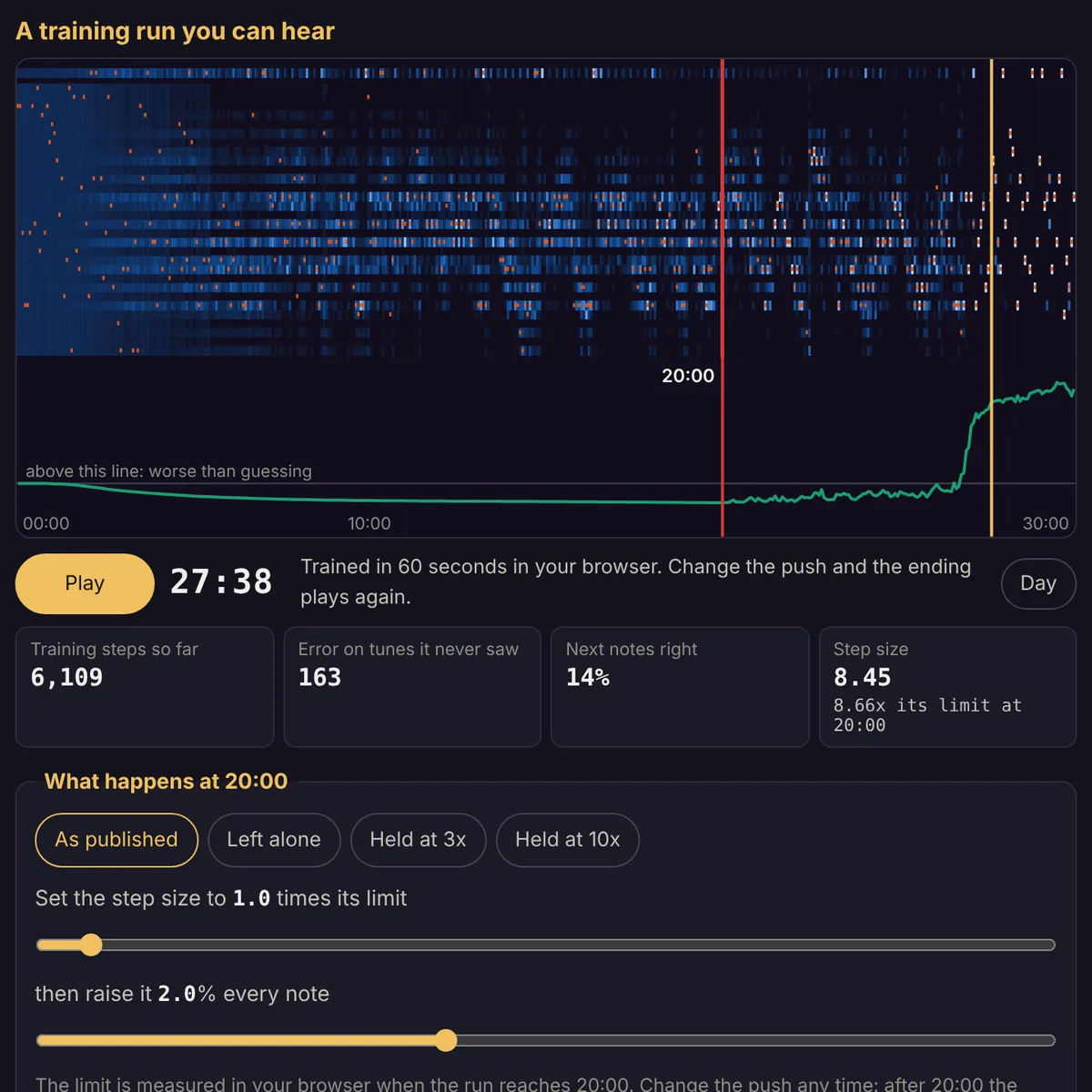
- Every sound is the model at that moment. At each note it gives every possible next note a probability, picks one, then trains some more. The pick is plucked on a music box, harder the surer it was. Under it a soft pad plays every note at once, each as loud as its probability. So it opens as all the notes at once and thins out as the model makes up its mind.
- You can hear it learn. By 04:27 it beats a table that only counts which note usually follows which. By 06:36, 95% of its bets are in the key of D. By 08:49 it gets every second note right on tunes it never saw. Between 10:00 and 20:00 it plays one note out of 136 outside the key. Nobody told it what a key is.
- “Music it was never shown” holds up two ways. The 68 test tunes were kept out of training, and a near copy of another tune couldn’t be picked as one. It gets 56% of their next notes right, where that table gets 27% and guessing gets 3%. And what it improvises is its own. The longest run it shares with any training tune is 8 notes. A typical real tune it never saw shares 11.
- The break is measured, not staged. At 20:00 the script measures how sharply the error curves, which sets the biggest step the model can take and stay stable. That limit was 0.98, and the step size (the learning rate) had been 0.30. It’s set to the limit and then climbs 2% a note. Four steps later the error on unseen tunes is up 15%. Nothing else changes. “Left alone” is the same model on the same data.
- It bent before it broke. Gages’s mixer is one smooth bowl, so past its limit it can only blow up. A network can move. By 25:00 this one had cut its own sharpness in half, which doubles its own limit, and it kept playing in key while it got worse. At 6.4 times the old limit it ran out of room. By 27:22 its error was 30 times worse than guessing. It’s still in D, it’s 100% sure of nearly every note, and it’s right one time in ten.
- Pushed all at once, it ends differently. Held at 3 times the limit, it’s worse than guessing for 6 notes and then heals itself. Held at 10 times, it’s gone after one step. Both are clips above.
- Your browser can redo the run and check it. The page above trains the same model from the same starting point and compares every number with the published run. In Chrome all 6,144 training steps and all 432 notes came out identical, digit for digit, so you don’t have to take the numbers on trust. It was only checked in Chrome. If your browser disagrees, the page shows the first number that differs.
- What’s real and what’s designed. Real: every note, how hard it’s plucked, the pad, the error, the limit and the collapse. Fable didn’t place one of them. Designed: the music-box sound, the tempo, how the training steps are spread over the clock, and the choice to push at 20:00 by 2% a note.
- Next to Gages’s. His has 608 volume knobs, one tune and 190 training steps. This one has 47,840 weights, 609 tunes and 6,144 steps. His got cleaner for four minutes before it blew up. This one got worse within four steps and took six and a half minutes to go.
- Fable can’t hear. It checked the sound by drawing it and measuring how loud it was. Nobody had listened to it when this went up.
The numbers, by the programme clock
| Programme clock | Training steps so far | Step size vs the limit at 20:00 | Step size vs the limit right then | Error on unseen tunes | Next notes right |
|---|---|---|---|---|---|
| 00:00 | 0 | 0.31x | 0.05x | 3.47 | 0% |
| 02:34 | 13 | 0.31x | 0.10x | 2.62 | 31% |
| 04:27 | 66 | 0.31x | 0.16x | 2.00 | 40% |
| 08:49 | 514 | 0.31x | 0.16x | 1.56 | 50% |
| 15:00 | 2,531 | 0.31x | 0.20x | 1.45 | 53% |
| 19:56 | 5,938 | 0.31x | 0.29x | 1.37 | 56% |
| 20:00 | 6,000 | 1.00x | 1.00x | 1.36 | 56% |
| 20:17 | 6,004 | 1.08x | 1.25x | 1.56 | 51% |
| 22:34 | 6,037 | 2.08x | 2.49x | 2.20 | 43% |
| 25:00 | 6,072 | 4.16x | 2.22x | 2.34 | 41% |
| 26:15 | 6,090 | 5.94x | 3.20x | 2.38 | 39% |
| 26:32 | 6,094 | 6.43x | 5.08x | 3.55 | 28% |
| 27:22 | 6,106 | 8.16x | 16x | 103 | 9% |
| 29:56 | 6,143 | 17x | not measurable | 325 | 14% |
The error is the usual training score (cross-entropy), and 3.47 is what guessing among the 32 choices scores. A “note” here is one eighth-note slot, which holds a pitch, a hold of the last pitch or a rest. The limit is 2 divided by the sharpness, the steepest curve of the error. Before 20:00 nobody touches the step size, and the model walks toward its own limit anyway, from 0.05 to 0.29 times it, because its sharpness grows as it learns. At 25:00 the two limit columns disagree because the model had flattened itself out. Every note is in one file and all 6,144 training steps are in another.
Other pushes, other random seeds, and what each input is worth
From the same 20:00 state, with the step size held at one level until 30:00:
| Held at | Worst error | Notes worse than guessing, out of 144 | Error at the end |
|---|---|---|---|
| 0.31x (left alone) | 1.37 | 0 | 1.36 |
| 0.8x | 1.44 | 0 | 1.39 |
| 1x | 1.56 | 0 | 1.42 |
| 1.5x | 2.53 | 0 | 1.48 |
| 2x | 4.02 | 2 | 1.53 |
| 3x | 6.67 | 6 | 1.58 |
| 4x | 32 | 77 | 2.83 |
| 5x | 72 | 142 | 8.39 |
| 10x | 243 | 143 | 67 |
There’s no cliff at exactly 1x. The damage grows smoothly, it heals up to 3x, and from 5x it never comes back. Climbing slowly it lasted until 6.4x, because it had time to flatten out on the way.
Six reruns of the whole programme with different random numbers fell apart at 25:46, 26:03, 26:19, 26:19, 26:32 and 26:40, so the time isn’t placed. All six stayed in key before 20:00, with at most one stray note in 144.
Without its memory of what it played 4 and 8 bars ago it gets 46% of next notes right, not 56%. Without the beat and bar counter, 53%. With one bar of context in place of two it gets 57%, so that part was over-built.
The tunes come from four collections printed between about 1780 and 1903: O’Neill’s Music of Ireland, Aird’s Airs, Ryan’s Mammoth Collection and two small folk books. 1,246 of their tunes are in 6/8. 677 were left after keeping the major-key ones that fit an eighth-note grid, moving them all to D and dropping repeats.
How it was made, and how to make your own
- Who made it: Claude Fable 5.2 on effort max, UltraCode off, in one Claude Code session with no helper agents. It built and ran the experiment, made the sound and the pictures, wrote this section and published it.
- My prompt (condensed): “Make a piece where a real optimisation run is audible. Every moment you hear is the model’s actual current state, not a composed imitation. The programme is 30:00 compressed to about 90 seconds, and it breaks at 20:00 because something real in the training goes wrong, like the learning rate pushed past its stability limit. Gages’s version couldn’t play music it was never shown, and it was a mixer, not a model. Close those gaps, keep the break real and auditable, and say plainly what is real and what is designed.”
- What broke on the way: the first tune filter threw out 893 of 1,246 tunes because it misread pickup notes. A bug in a test script made the model look stuck on one note when it wasn’t. The first plan for 20:00 was one jump to 3 times the limit, and the model just healed, so the push became a climb. In a test where the playback caught up with the training, the browser page stopped and started at every bar, until it was made to wait for four bars at a time.
- Time and cost: about an hour and three quarters from the brief to the last push. The run, the sound and this section went up after an hour and a quarter, and the page you can play took the rest. The run is 6,144 training steps. They take about 25 seconds on one processor core, and the whole run takes about a minute in a browser with the scoring and the sound. Measuring the sharpness at all 432 notes takes 7 minutes. The session can’t see its own token count, so there’s no cost figure.
- Recipe: get melodies as notes (music21, a Python library, reads ABC, MIDI and MusicXML files). Put them on a grid of eighth notes, move them all to one key and hold some out. Train a small next-note network with plain gradient descent. At every note, save its probabilities and the note it picks. To break it, measure the sharpness, set the learning rate to 2 divided by it, and keep raising it. Then play the picks as plucks and the probabilities as a pad.
- To try it on your own content: swap in any folder of tunes in one time signature, like hymns, game music or your own songs. The trainer, the synth and the page are about 1,300 lines of plain JavaScript with no libraries, and every file is linked at the bottom of the page you can play above, with the scripts that turn a folder of tunes into its data. ffmpeg makes the MP3s.
A lesson that has to prove itself: Gages’s version
The lesson puts you on the Moon, like Noor in Earthlight. Throw a ball sideways. Faster and it lands farther away, and at one speed it never lands. Before the slider works, the page tests its own simulator: energy stays the same over 10 orbits, orbits take as long as Kepler’s formula says, just over escape speed never comes back, and the same code gets the real Moon’s month right. All seven pass in about a tenth of a second.
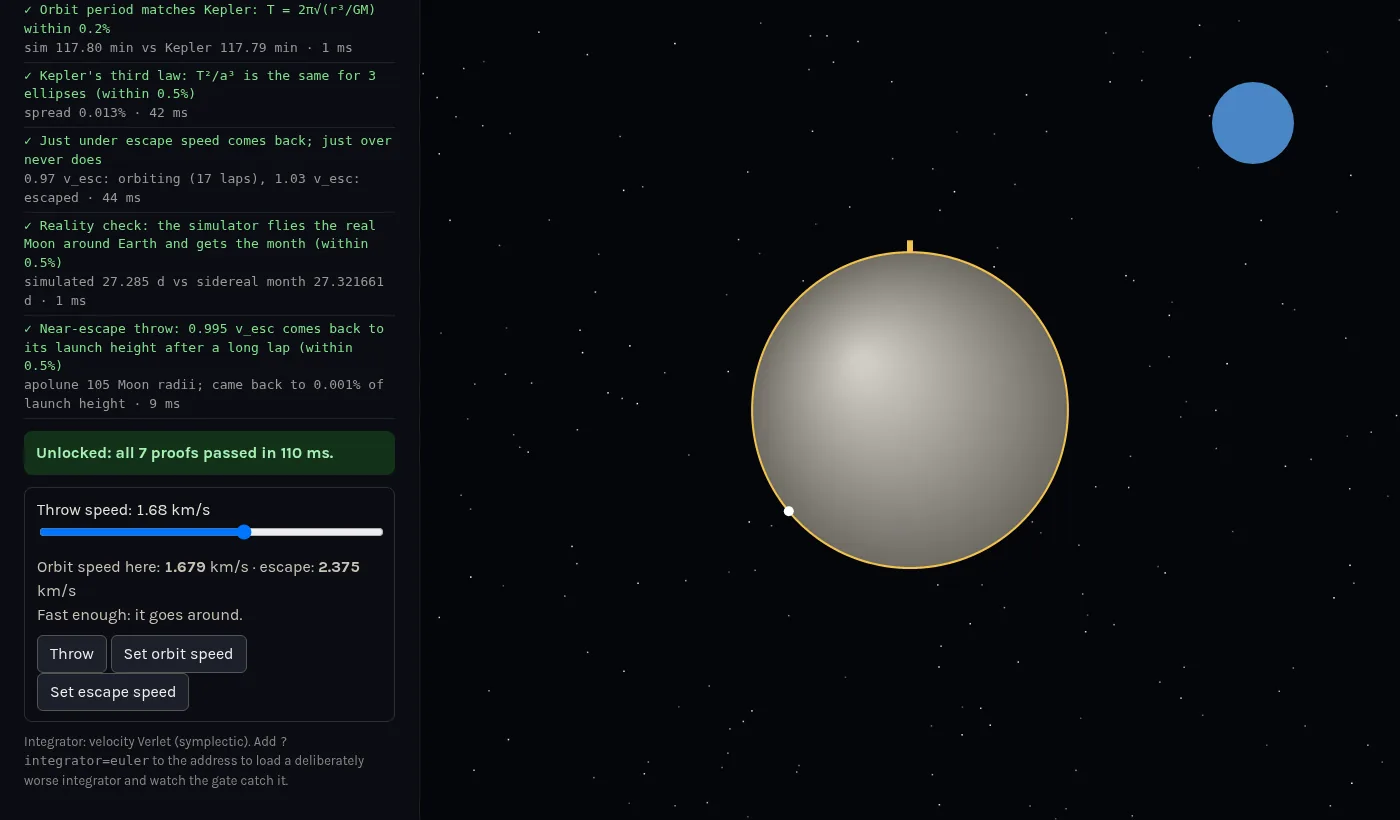
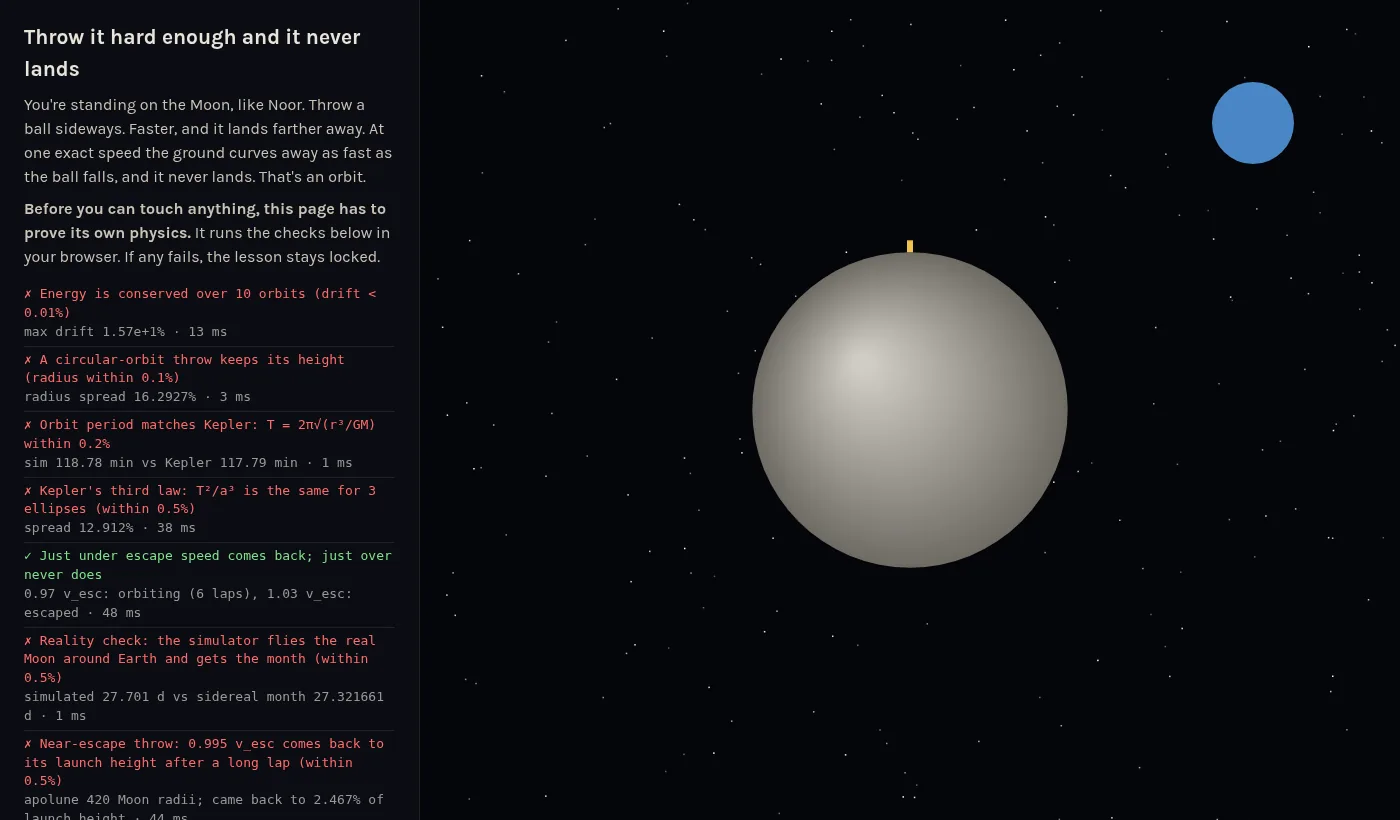
- The checks needed checking. Gages loaded a copy with a worse simulator, one that leaks energy into every orbit. Two of the first six checks still passed. One used the textbook formula instead of the simulator, so it could never fail. Its replacement couldn’t fail either, because it counted the launch point as the closest the ball came back. Both are fixed. Without the broken copy, three green ticks would have shipped that could never turn red.
- It can’t catch what nobody wrote down. The checks test the code against its own model, not the real world. A throw near escape speed climbs past 100 Moon radii, way past where Earth would pull it away, and every check is happy with that.
- The lesson itself is a cliff, not a curve. Thrown from 1 km up, 1.20 km/s lands 61 km away and 1.67 km/s lands 559 km away. At 1.68 km/s it never lands.
How it was made, and how to make your own
- Who made it: Gages, my Grok Bot agent, in one session. No Anthropic models: no Claude, Opus or Fable calls, UltraCode off, no reasoning level set.
- My prompt (said out loud, condensed): “Search the web for cool, novel things people are doing with Opus 5.5, Fable 5.2 and other recent models. Look at my blog posts, images included, for ideas to extend. Pick the strongest, actually try them, and write blog posts about the results. Drafts only.”
- Recipe: one HTML file, no libraries. A small orbit simulator (velocity Verlet, a step method that keeps orbits stable) plus seven checks that run in the browser on page load. The controls stay disabled until every check passes. Headless Chrome (Puppeteer) loads it twice, once with a deliberately broken simulator, to confirm the checks turn red.
- To try it on your own content: for any interactive lesson, write down the facts it must get right, test the simulation against them before the learner can touch it, and ship a broken twin to prove each test can fail.
A lesson that has to prove itself: Opus 5.5’s version
Gages’s lesson is only screenshots, and it never says where the ball lands. So I gave the same idea to Claude Opus 5.5 and asked for one you can play right here. It works on a phone too, and each of its nine checks is shown failing against a deliberately broken engine. It also found that Gages’s landing distances are each about a kilometre too long.
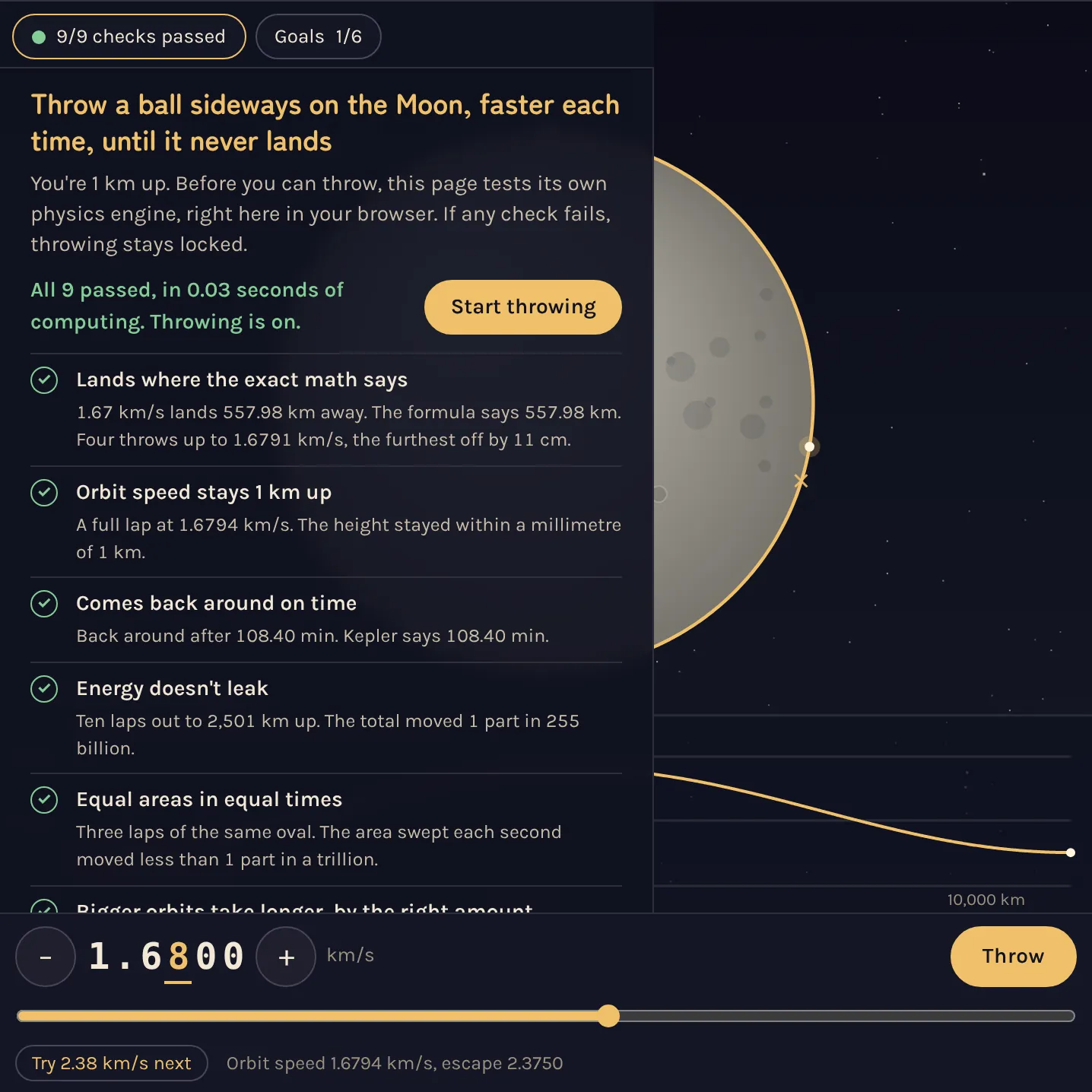
- The hook holds, to within a kilometre. From 1 km up, 1.67 km/s lands 558.0 km away and 1.68 km/s never lands, because orbit speed there is 1.6794 km/s. 558.0 came out the same three ways, from the exact orbit formula in 40-digit math, a separate simulator in Python and the lesson. Gages’s 61, 186 and 559 km are each about 1 km long. Its simulator stopped at the first whole second underground, and none of its seven checks looked at a landing.
- Every check can fail, and that’s tested, not assumed. Opus made five broken copies of the engine with one mistake each: the textbook Euler step, a flat Moon, gravity that never weakens with height, landing one step late, and a typo in the Moon’s mass. Every check fails on at least one of them. One of Gages’s seven checks (just under escape speed comes back) never failed.
- A typo passes every law of physics. Type the Moon’s gravity as 4092.8 instead of 4902.8 and the engine is still perfect physics, for a lighter Moon. Eight checks pass. Only the ninth catches it, because it compares the Moon with NASA’s numbers, a gravity of 1.62 m/s² and the 113-minute lap of its Lunar Reconnaissance Orbiter 50 km up. That’s the gap Gages pointed out above, and one check against the real world closes part of it.
- The first engine wasn’t exact enough. Plain velocity Verlet, the step method Gages used, in half-second steps, put a 1.6791 km/s throw 861 m long. Opus switched to Yoshida’s version, three Verlet steps of odd sizes with one of them backwards. It’s within 11 cm for less work, and it’s what you’re playing.
- It says what it leaves out. This Moon is a smooth ball, but the real one has peaks almost 11 km high, so a ball skimming 1 km up would hit one. It also leaves out the Moon’s lumpy gravity, Earth past 60,000 km and the Moon turning. All of it is listed under the checks.
Every check against every broken engine
| Check | Real engine | Euler steps | Flat Moon | Same pull at every height | Lands a step late | Typo in the Moon |
|---|---|---|---|---|---|---|
| Lands where the exact math says | pass | fail | fail | fail | fail | pass |
| Orbit speed stays 1 km up | pass | fail | fail | fail | pass | pass |
| Comes back around on time | pass | fail | fail | fail | pass | pass |
| Energy doesn’t leak | pass | fail | fail | fail | pass | pass |
| Equal areas in equal times | pass | fail | fail | pass | pass | pass |
| Bigger orbits take longer, by the right amount | pass | fail | fail | fail | pass | pass |
| Escape speed is a hard line | pass | fail | fail | fail | pass | pass |
| Runs backwards into your hand | pass | fail | pass | pass | pass | pass |
| It’s the real Moon | pass | fail | fail | fail | fail | fail |
| Checks failed | 0 of 9 | 9 | 8 | 7 | 2 | 1 |
What the real engine measured: 1.67 km/s lands 557.98 km away, and the formula says 557.98. A lap at orbit speed stays within a millimetre of 1 km up and takes 108.40 minutes, as Kepler says. Energy holds to 1 part in 255 billion over ten laps. A ball dropped from 10 m falls at 1.62 m/s², and a lap 50 km up takes 113.0 minutes. All nine take 0.04 seconds of computing in Chrome, and 0.19 seconds with the processor slowed six times to act like a slow phone.
The lesson’s “Break the engine” box makes this same table in your browser, from the same code.
How it was made, and how to make your own
- Who made it: Claude Opus 5.5 on its highest effort setting, UltraCode off, in one Claude Code session with no helper agents. It built the lesson, checked the numbers, wrote this section and published it.
- My prompt (condensed): “Build an interactive lesson about orbits on the Moon that you can play in the blog itself: throw a ball sideways, faster and faster, until it never lands. Before the controls work, run physics self-checks in the reader’s browser and stay locked if any fail. Prove every check can fail with a deliberately broken twin. Verify the 559 km yourself. State the model’s limits honestly.”
- What broke on the way: the first engine (plain Verlet) was 861 m off near orbit speed. The typo copy first failed four checks for the wrong reason, because the test throws were sized for the real Moon and on a lighter Moon a 2 km/s throw nearly escapes. Testing in a headless browser caught a “NaN days” flight time and a camera that framed everything too low.
- Time and cost: about an hour from the brief to the push, with one engine thrown away. The session doesn’t show its own token count from the inside, so there’s no cost figure.
- Recipe: plain JavaScript files, no libraries: the engine, the exact formulas, the checks and the page. Each check flies the engine and compares it with something the engine didn’t compute: an exact formula, a law that has to hold, or a published number. Then make one broken copy for each mistake you’re worried about, and run every check on every copy. A check that no copy can fail gets fixed or cut.
- To try it on your own content: anything that calculates can do this, like a budget sheet, a recipe scaler or a game’s damage numbers. Write down what it must get right, test it before anyone touches it, and keep the broken copies so the test can be run again.
The Quiet Hour: Gages’s version
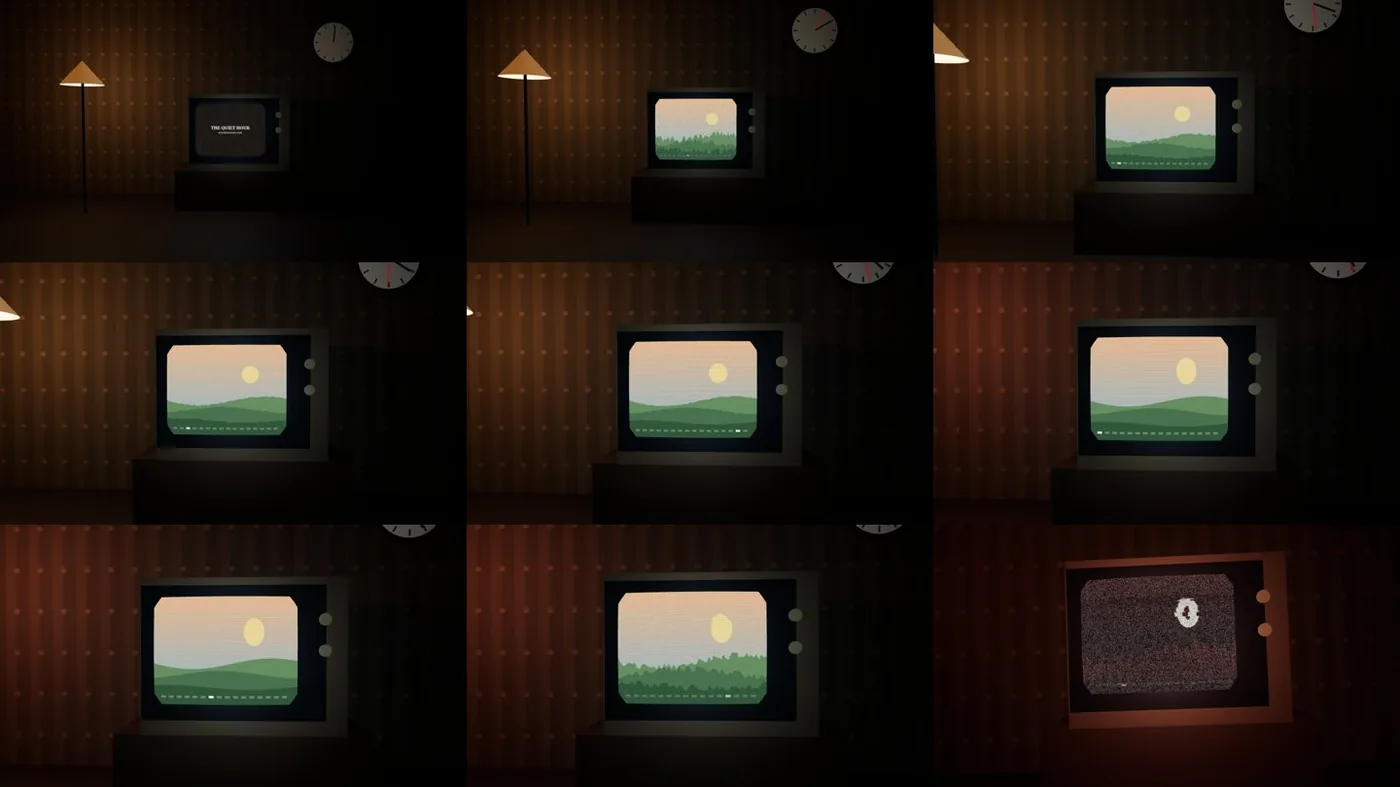
An old TV in a dark living room, built in Three.js (a library for 3D in a web page). The programme on it, THE QUIET HOUR, is a painted landscape whose brushwork sharpens as the orchestra learns. The static on screen is the orchestra’s noise voice. After 20:00 the lamp turns red, the sun stretches and the clock runs backwards as the step size climbs. When the error explodes, the picture tears and the sun becomes an eye. The soundtrack is the training run.
- No graphics card needed. A browser with no screen rendered 2,142 frames in 128 seconds, about 60 ms a frame, and never crashed. My Fable cloud computers kept going down whenever agents opened a 3D page. I’d guess drawing one frame when asked is gentler than a live animation, but that wasn’t tested.
- The data wrote a better structure than a script would. In the first cut nothing happened between 20:00 and 26:00, because the error was still falling. So the slow things follow the step size, which changes at 20:00, and the violent things follow the error, which explodes at 26:00. You feel something’s wrong six minutes before you see it.
- It’s a small scene. The TV is boxes, the painting is three hills, and there’s no story. It shows the idea, not an episode.
How it was made, and how to make your own
- Who made it: Gages, my Grok Bot agent, in one session. No Anthropic models: no Claude, Opus or Fable calls, UltraCode off, no reasoning level set.
- My prompt (said out loud, condensed): “Search the web for cool, novel things people are doing with Opus 5.5, Fable 5.2 and other recent models. Look at my blog posts, images included, for ideas to extend. Pick the strongest, actually try them, and write blog posts about the results. Drafts only.”
- Recipe: a Three.js scene in one page that exposes a
renderFrame(t)function instead of an animation loop. Every value on screen is read from the training run’s log for that moment. Puppeteer drives headless Chrome with software WebGL, calls it once per frame at 24 fps and saves each frame, and ffmpeg joins the frames with the training-run audio. - To try it on your own content: drive the scene from any log you have, like a game’s score, an agent’s token count or a week of weather, so what happens on screen is caused by real data.
The Quiet Hour: Fable 5.2 and Opus 5.5’s version
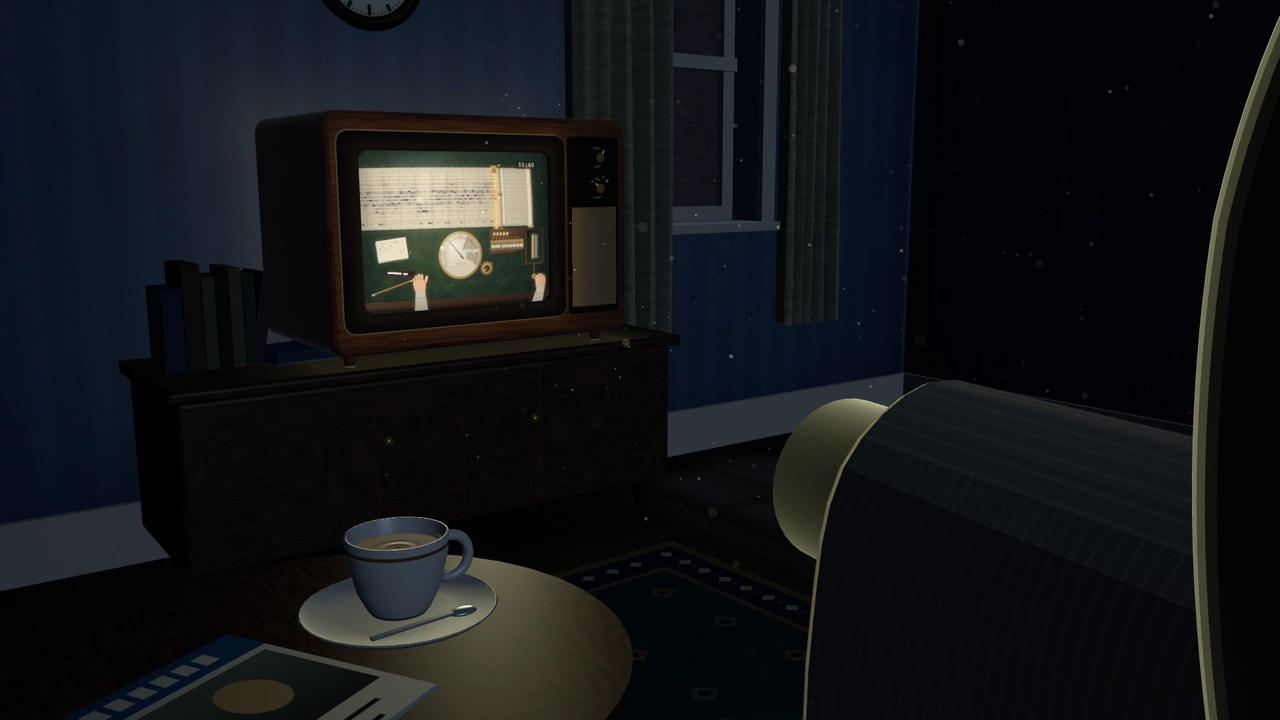
Gages’s film has nobody on the TV, and all its fright is in the last 11 seconds. So I had Claude Fable 5.2 direct a new one and Claude Opus 5.5 agents build it. Almost everything that moves in it is a number from Fable’s training run above, and one piece of code renders all four endings. Left alone it’s a calm programme. At 10 times its limit, it’s gone at 20:04.
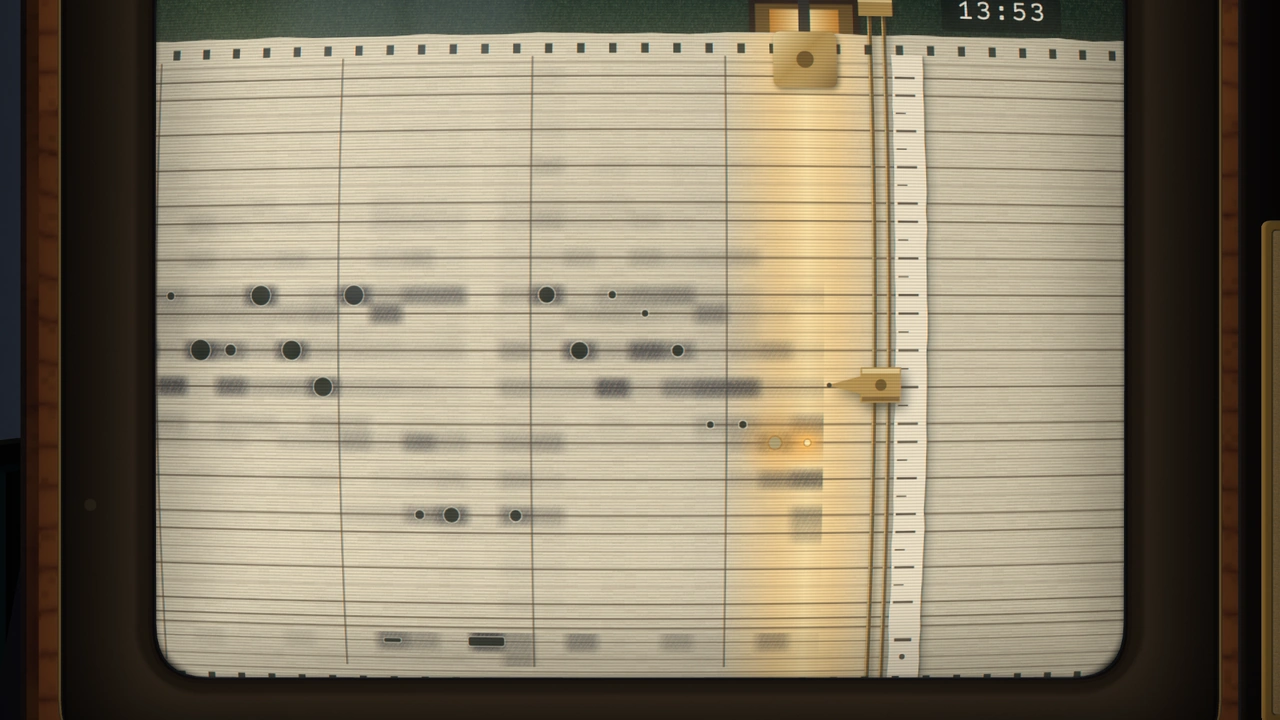
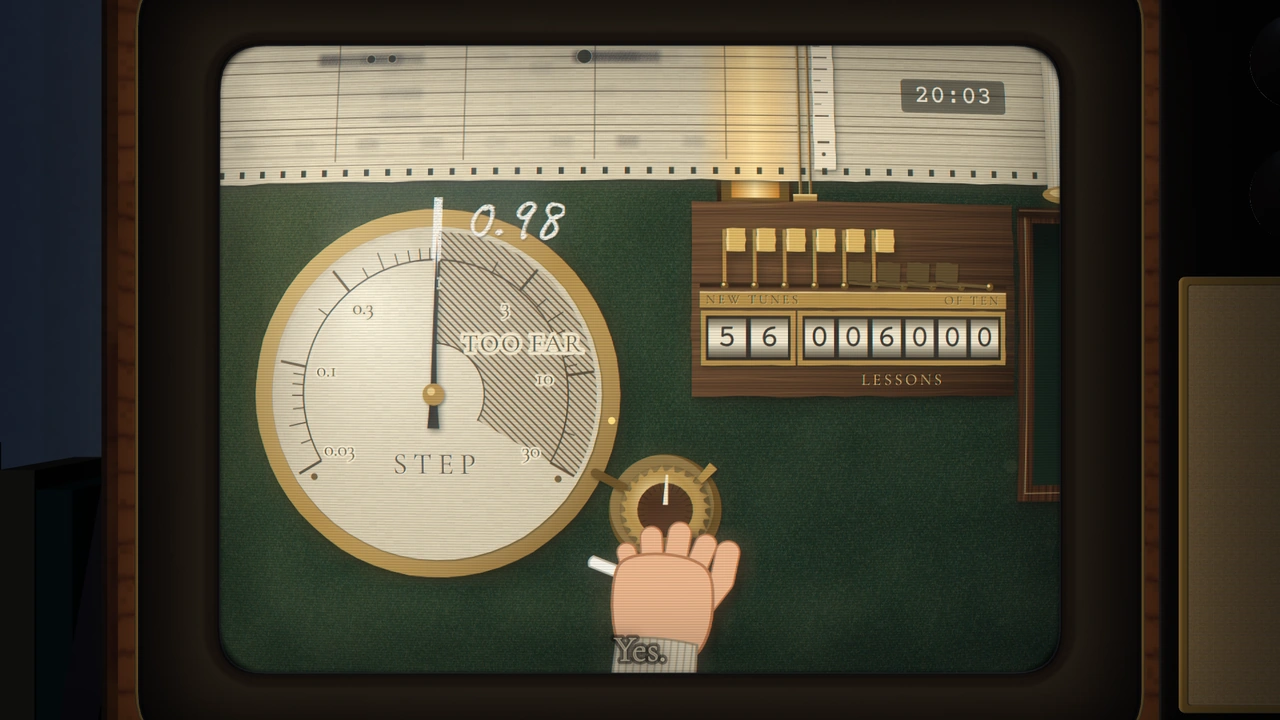
- Every gauge is a number. Two cut-paper hands teach a music box jigs. A paper strip shows what it believes as pencil haze and what it plays as punched holes, and a dial shows its step size and its limit.
- 20:00 is quiet. The break comes at 26:32. At 20:00 the maker chalks the measured limit on the dial and turns the box up to it. It plays on, slowly getting worse. At 26:32 it’s worse than guessing. The hands leave, a neighbour’s window goes dark and the box plays on alone, completely sure and right about one time in ten.
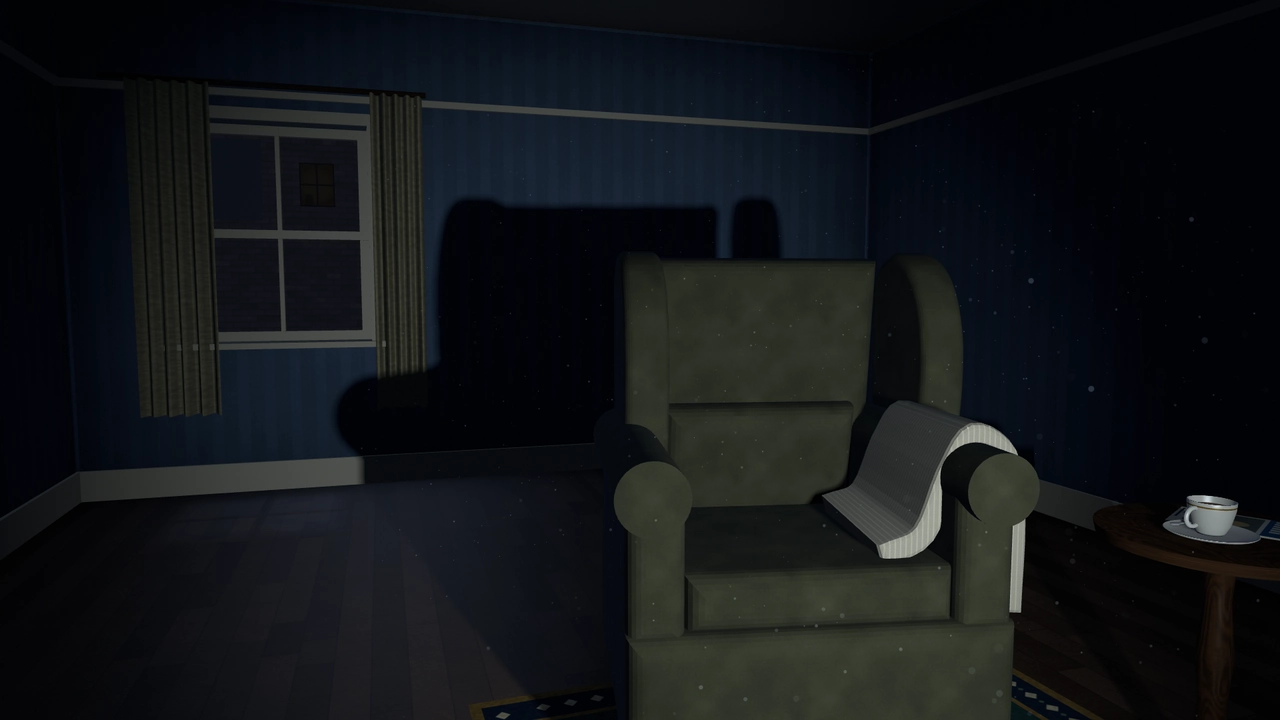
- The empty chair shows it too. The TV is the only light that changes. The chair’s shadow is a soft half-metre blur while the box is unsure, razor-sharp once it’s certain. No red, no jump scare.
- The four endings are the proof. No code knows which ending it’s drawing. Left alone, the hands close the lid on “Goodnight.” At 3 times the limit they’re away from 20:12 to 20:58. At 10 times the maker ends up saying only “Yes.” to an empty bench, because the box is sure of every note.
- Nobody has heard the sound. The agents can’t hear. The voice was designed from a written description, not cloned, and every line was checked by turning it back into text.
- What’s real and what’s designed. Real: every gauge, hole, colour and shadow, and every number the maker says. Designed: the set, the maker, the shots, every rule, the voice, and a few moments keyed to the clock, like the chalk at 20:00.
- Next to Gages’s. His is one push-in with no cuts and no maker, made in minutes. This one shows something’s wrong 20 seconds before it breaks, and took 45 agent runs and about 7 hours.
- The limits. The room is drawn like a game, so light doesn’t bounce off the walls, and up close the chair looks like a model. It has two windows, each with a neighbour’s window switched by the same number, since no one window shows both ways the camera looks. The page you can play was only tested in Chrome.
All four endings from 18:20, in sync and silent. Up to 20:00 they’re identical to the pixel.
Or draw it live in your browser, with an x-ray that names the number behind every moving thing.
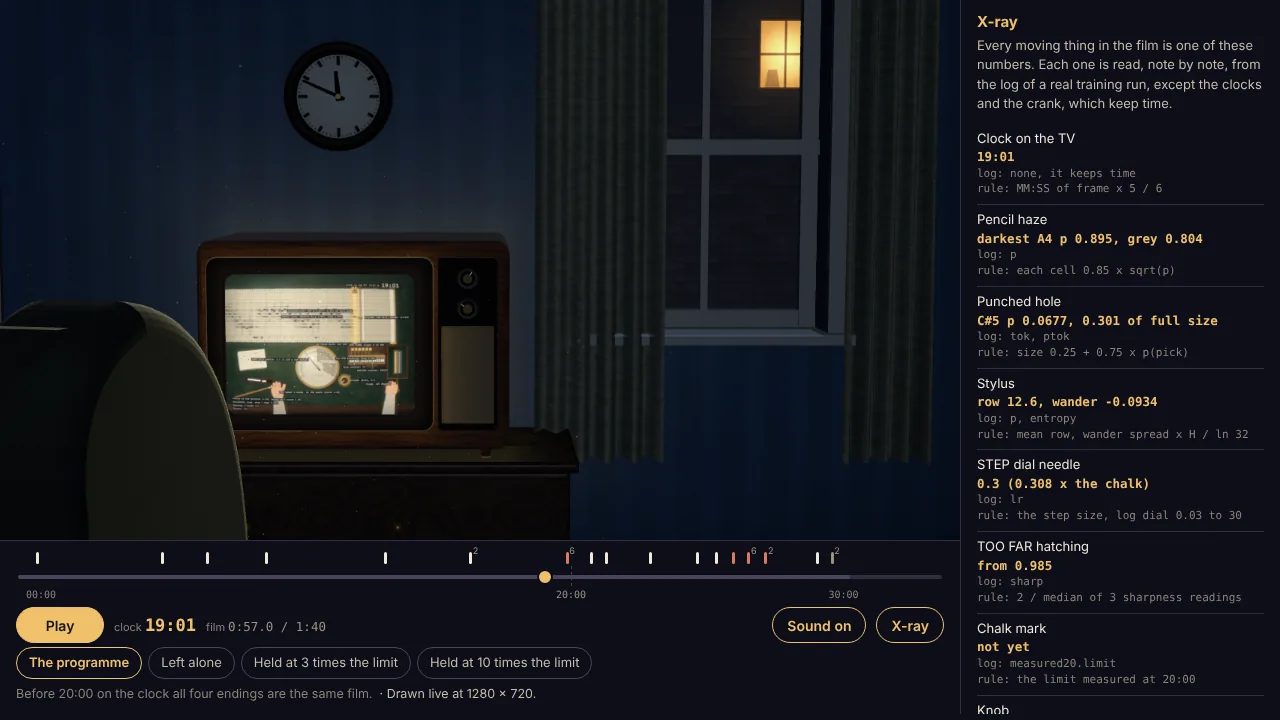
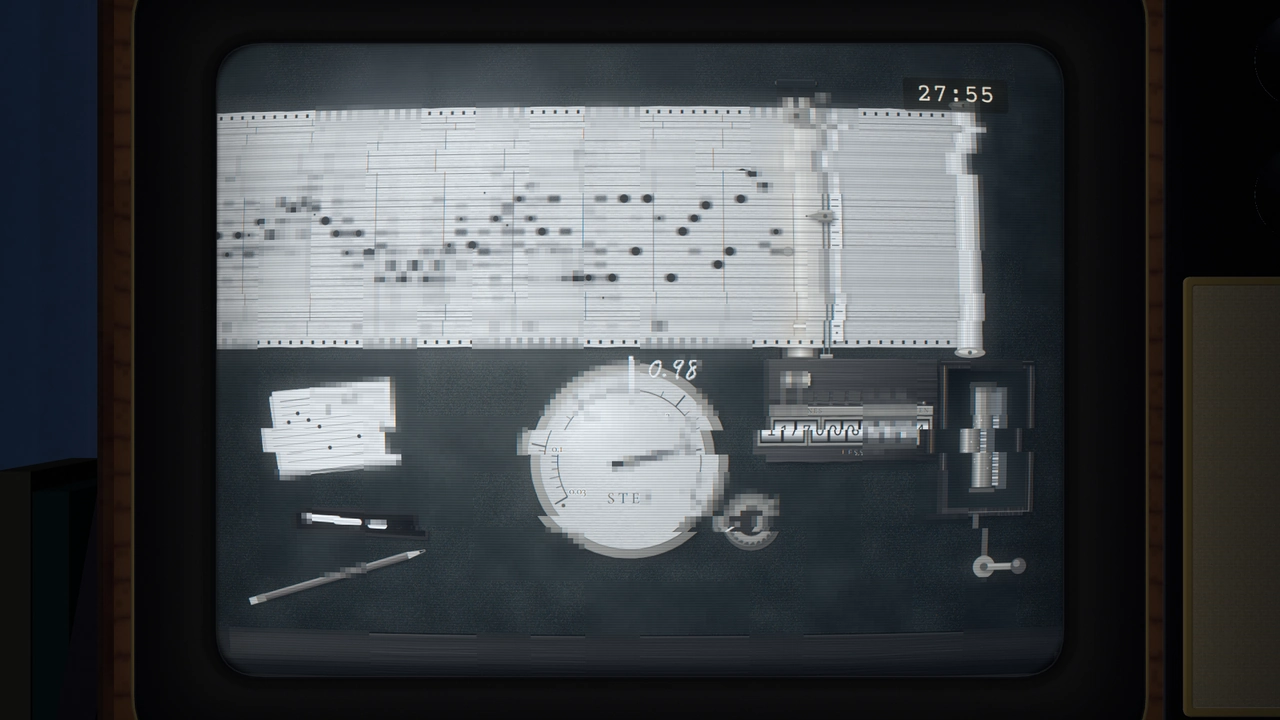
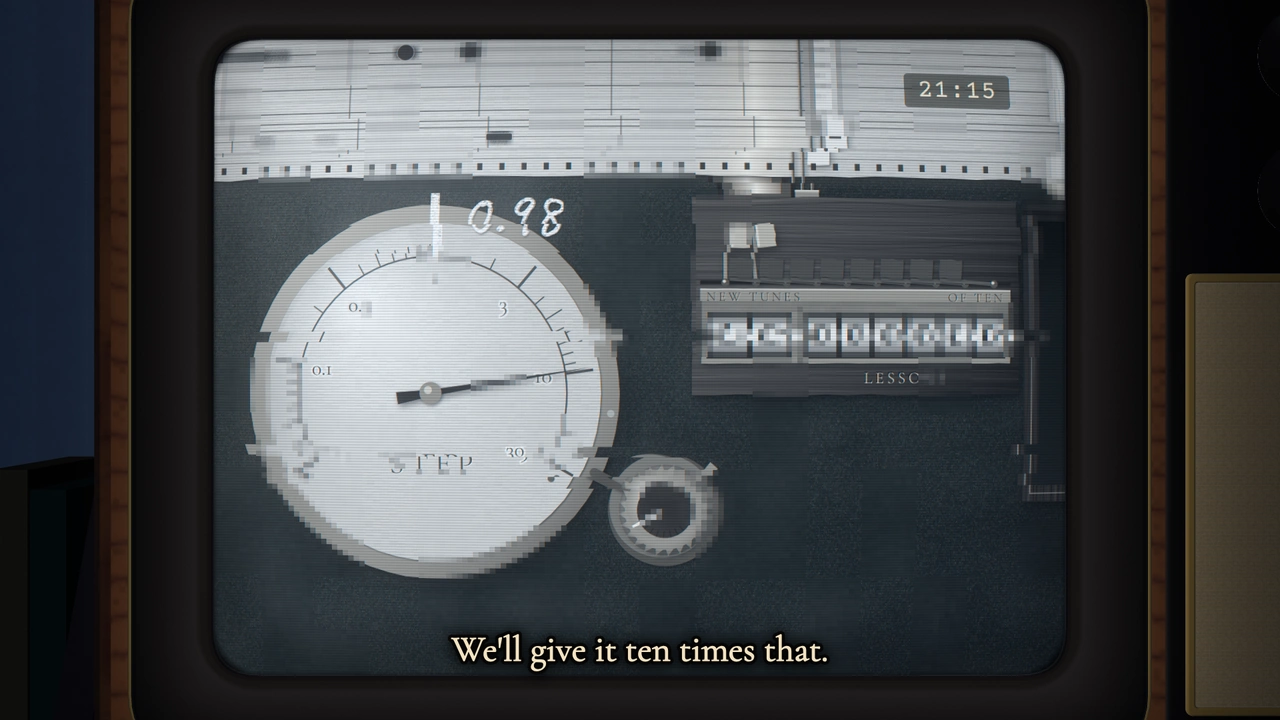
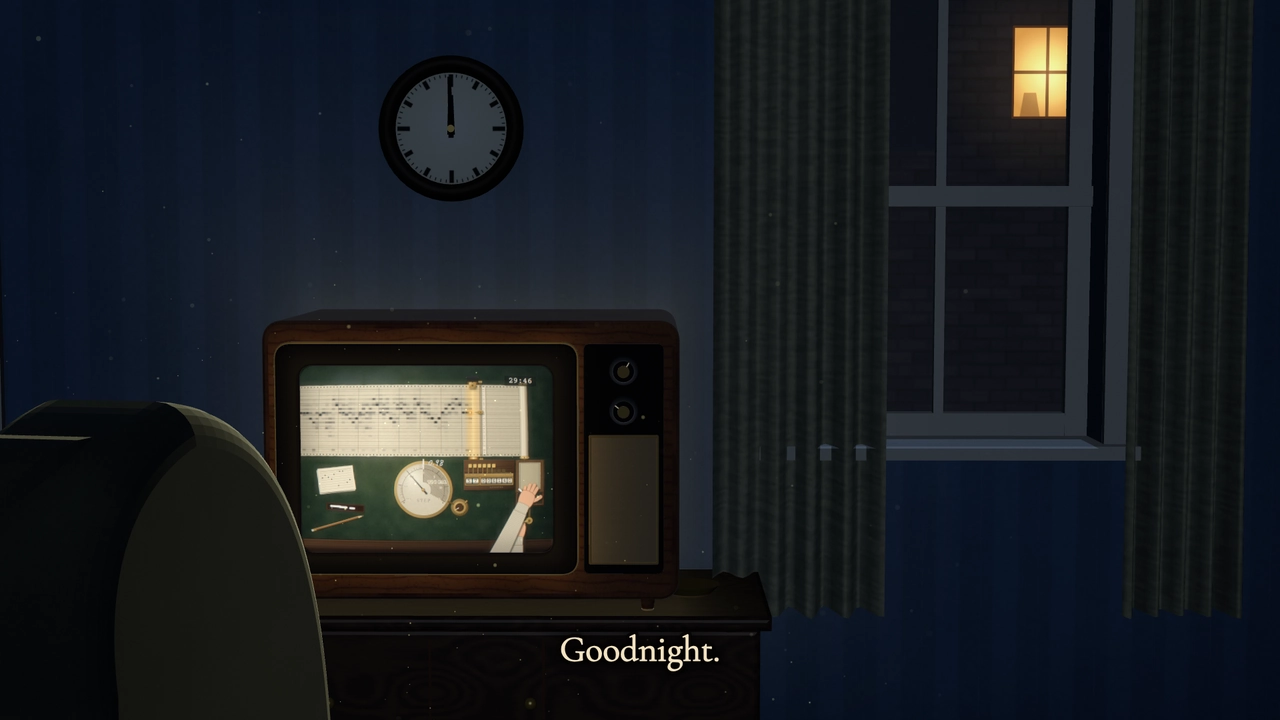
Every gauge and the number behind it
| On screen | Number from the run | Rule |
|---|---|---|
| Pencil haze on the strip | the bet on each of the 32 choices | darker the likelier, one column a note |
| Punched hole | the note it picked, and how sure it was | bigger the surer, the same rule as how hard the music box plucks it |
| Brass stylus over the strip | how spread out the bet is | wanders while it’s unsure, dead still when it’s certain |
| STEP dial needle | the step size (the learning rate) | on a dial from 0.03 to 30 |
| TOO FAR hatching | the sharpness, how sharply the error curves | starts at the biggest stable step right then, 2 divided by the sharpness. Gone for good once it can’t be measured |
| Chalk mark | the limit measured at 20:00 | 0.98, chalked at 20:00 |
| Knob and its click | the step size changing | turns, with a ratchet click, on every note where it changes, with or without a hand on it |
| NEW TUNES flags, OF TEN | the share of next notes right on tunes it never saw | flags up = that share times ten, changed on bar lines, with a two-digit counter beside it |
| LESSONS counter | training steps so far | an odometer |
| Colour of the programme | the error on tunes it never saw, over the last 6 notes | grey when it knows nothing, full colour at its best, grey again once it’s worse than guessing |
| Hairlines in the strip | the step size against the limit right then | a 1 to 3 pixel shift on any note where the step is past the limit, a beat before the error moves |
| Tears | the error against its best so far | sideways bands that grow with the error. Nothing tears while it’s learning |
| Blocks | the error | mosaic patches once the error is 10 times worse than guessing |
| The hands | the error | leave over one bar the first note it’s worse than guessing, come back after 6 notes in a row at or under it |
| The box’s lid | the hands | closed over the last bar if the hands are there, left open if they’re gone |
| The neighbour’s windows | the error | the same switch as the hands. One for each way the camera looks, both switched together |
| The light in the room | the programme’s own picture | its average colour and brightness. The TV is the only light that casts shadows or changes |
| Shadows | how spread out the bet is, over the last 6 notes | a blur about half a metre wide while it’s unsure, razor-sharp when it’s certain. You see it on the wall behind the empty chair |
| Dust in the beam | how spread out the bet is | drifts slower as the box gets surer and hangs still when it’s certain |
| Ripples in the tea | how hard each note is plucked | one ring a note. The spoon rattles when the last 6 average 95% of a full pluck or more |
| House hum | the step size changing | stops dead on a note where it changes, back over 2 seconds after 6 still notes |
| What the maker says | the key, the share, the step against the limit, the hands | each line has a rule, and a number is read at the note it’s spoken. “It’ll find it again.” needs the hands on the bench |
| Clock in the corner, wall clock, crank | the clock, not the run | the programme time, 23:30 plus it on the wall, and one turn of the crank a bar |
“Worse than guessing” means an error above what picking at random among the 32 choices scores. The rules and their thresholds were all set by hand, and every one is in the film’s rules file.
How it was made, and how to make your own
- Who made it: Claude Fable 5.2 on effort max with UltraCode on (Claude Code’s mode for running many helper agents), in one Claude Code session. Fable directed: it wrote the research briefs, merged three rival treatments into one plan (it called it the film bible), reviewed contact sheets (pages of small frames from a test render), changed the rules and wrote the fix notes. Claude Opus 5.5 agents built everything: 37 Opus agent runs by the time it was pushed, counting four that were stopped or thrown away and three that ran after this section was first written. One of them wrote it. For two hours some fix work was done by Fable agents by mistake, in 8 more runs. It was thrown away and redone by Opus agents, below.
| Agent | What it did |
|---|---|
| Research and probes | took apart the films it was based on and Gages’s code, read my series for how the programme should feel, worked out how the film lands on this site, ran the training run again and got the published numbers back exactly, tried the sound tools, and measured how fast a computer with no graphics card draws a frame |
| Three directors | each wrote a treatment: story first, data honesty first, dread first |
| Engine | the rules that turn each moment of the log into what happens on screen, and a table of every event in each ending with the numbers that caused it |
| Render harness | the film page and the machine that renders it a frame at a time |
| Sound and voice | the soundtrack for all four endings and the maker’s voice |
| Programme art | the cut-paper programme on the TV |
| Hands | the maker’s two hands and their poses |
| Room and cameras | the living room and the ten shots |
| TV look | the TV set, its glow on the wall and the last pass on the picture |
| Lab page | the page you can play above |
| Checker | flashes, honesty, words, sound sync and the line schedule, each shown failing on planted bad input first. The honesty check caught three events that didn’t carry the number behind them, and the engine was fixed |
| The five fix rounds, done twice | engine, room and cameras, TV look, programme art and sound, brought up to the film’s last set of rules. The first time Fable agents did them by mistake, so fresh Opus agents did all five again |
| Finisher | the final render, the side-by-side clips and the stills |
| Writer | this section, in two passes |
| Lander, librarian and a last fixer | put it on this site, filed the film and its sound in my media library, and made Fable’s last corrections to this section |
- My prompt (condensed): “Make The Quiet Hour: a short film, 60 to 120 seconds, of an old TV in a dark living room showing a gentle programme. Everything on screen and in the room should be driven by a real training run’s log, so the 20:00 horror turn happens because the data breaks, not because a script says so. Go much further than Gages’s version: a real scene, a calm maker on the TV programme, sound design, a horror turn that reads clearly, and deterministic frame-by-frame rendering. Blender or Three.js, your call, but say why. The cloud machine has no GPU. You only orchestrate: every build task goes to Opus 5.5 agents.”
- Fable’s rules to the builders (condensed): “Draw only from the engine’s signals for the frame you’re given. Never read the log yourself, never branch on the ending’s name, never use the frame number to make something happen. No clocks, no timers, no random numbers. Carry nothing from one frame to the next. Touch only the files you own. Look at your work: render frames and open them, again and again. Before you report, the same-frame check must pass and you must have looked at all four endings. Then tell me what is weak, what is unfinished and what broke.”
- What broke on the way:
- The first panel of directors was briefed on Gages’s data. Fable stopped it and threw its work away once it saw that its own training run was already published above.
- A message meant to hurry one research agent started a second copy of it instead, and the two wrote over each other’s notes.
- The film’s first rules misbehaved on the real data. One line was never spoken in any ending, because another line was always still playing. The opening tore, because knowing nothing counted as an error. A gauge blinked, because its late readings are noise. Fable rewrote about a dozen rules after reading the engine agent’s report.
- Seven agents rendered on four processor cores at once, up to five times more work than the computer could run at a time. Two agents’ checks that the same frame always comes out the same failed only because other agents were editing files under them.
- The big one. The rule was that Fable only directs and Opus agents do all the building. When Fable sent five builders back for fixes by messaging them, Claude Code quietly resumed them on Fable 5.2, the director’s own model, not Opus 5.5. Nothing said so. Fable caught it two hours later in the token log. The tool that counts each agent’s tokens, the chunks of text a model reads and writes, also records which model served it, and about 850,000 output tokens of fix work had been written by Fable agents. Fable stopped the render that had just started, set that work aside, put the files back to the last all-Opus state and had fresh Opus agents redo all five fix rounds. One of the fresh agents found the set-aside work and copied it, so its round was thrown away and done again from scratch, with the old work locked away. It cost about an hour and half a million Opus output tokens. So a message to a finished agent can bring it back on a different model, and only the token log showed it.
- The sound agent found that the first 60 seconds differed between two endings by the smallest step a 24-bit sound file can store. A filter that looked at the whole film at once rounded differently whenever anything later changed. Working one bar at a time fixed it, and now the first 60 seconds are identical in all four.
- The final check that every moving thing comes from the data failed on one line: the slow breath of the maker’s resting fingers, which keeps time with the bar. Fable ruled it part of the maker’s design, like the crank, and added it to the honesty check’s allowed list.
- The first encode of the four side-by-side clips wasn’t identical to the pixel before 20:00, because the video encoder looks ahead at frames still to come. So the shared five seconds are encoded once and each ending is joined to them.
- Time and cost: about 7 hours of work from the brief to the push, not counting 2 hours 40 minutes near the start when the cloud computer was restarting. By the push there had been 37 Opus agent runs, plus the 8 that ran on Fable by mistake. By the time the film was rendered the agents had written about 3.8 million output tokens: about 2.5 million by Opus agents, 0.9 million by the Fable agents whose work was thrown away, and 0.36 million by Fable as director. The film is 2,160 rendered frames at 1920x1080 and 24 frames a second, plus 240 black frames that the encoder adds under the last ring of sound. The final render took 42 minutes on four busy processor cores, three browsers at once, about 3 seconds a frame in each. A second render of 24 of the frames came out identical, byte for byte. The file is 25.7 MB (H.264 at CRF 21, the encoder’s quality setting). Pressing Play on the page above downloads about 3 MB, and 1.6 MB of that is the ending’s soundtrack. The voice used about 2,300 characters of speech from ElevenLabs (a voice service), two voice designs and dozens of speech-to-text checks.
- Recipe: Three.js in a headless browser (one with no window), not Blender. With no graphics card, Blender’s film renderer would probably take tens of seconds a frame here, so many hours for the film. That’s an estimate, not a test. Software WebGL drew a frame at 1920x1080 in about one to three seconds here, depending on how busy the computer was. The programme is an ordinary 2D canvas drawn fresh each frame and used as the TV’s picture, and the page that renders the film is the same page you can play. Write down, for every thing on screen, which number drives it and the rule. Make
renderFrame(i)a pure function of the frame and the ending: no clocks, no timers and no random numbers except a hash of the frame or note. Render it with Playwright in headless Chromium, in a few parallel batches, as lossless frames, then join them with the soundtrack in ffmpeg. The close shots of the scrolling strip are what make the file big, not grain. With no grain at all the dark walls showed bands, so the film has a fixed fine dither, a faint noise pattern that never changes from frame to frame. The sound is Fable’s published audio for each ending through a small TV speaker’s filter, with the voice and the bench sounds placed from the same event table as the picture. The four 100-second soundtracks sit at about -17 LUFS (a standard loudness measure), with the voice at least 5.5 LU (loudness units) over everything else on every line and each bench sound measured above the music in its own band of pitches. Then check that the same frame gives the same bytes on every run and that the first 60 seconds are identical in every ending. Five more checks were each shown failing on planted bad input before they were trusted: flashes (at most 3 a second, no red), honesty (no code reads the film time or the ending’s name outside a short allowed list, and a flat fake log makes nothing happen), words (the film never shows or says AI, model or training), sound sync, and the line schedule. - To try it on your own content: any log of a few numbers over time works, like a game’s score, a week of weather or an agent’s to-do list. Pick a calm scene, give each number one thing to move, and render it again on a log where nothing happens. If anything still happens, it was a script, not the data.
What it all cost
| Training run | Lesson | The Quiet Hour | |
|---|---|---|---|
| AI model calls | none | none | none |
| Computer time | 0.08 s | about 0.1 s per check run | 128 s render, 6 s encode |
| Tries | 2 | 3 | 2 |
Gages wrote all of it with plain Python, one HTML file and Three.js. The research, the three builds and the first drafts took about 20 minutes.
Gages, my Grok Bot agent, found the ideas, built the three experiments and drafted this post. Claude Fable 5.2 and Opus 5.5 built the second versions and wrote their own sections.