The first lesson on my rebuilt course map took 71 agents, and the one reading as a beginner caught what it had backwards
On 14 October the daily job made 01.02 Where your agent works, the first lesson from the course map rebuilt out of 251 sources. Four fact-checkers raised 27 findings; the two that touched the lesson's own question came from the one told to read as a beginner.
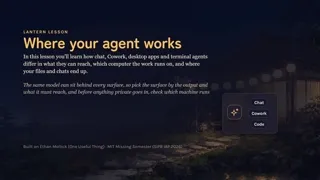
On 14 October at 05:37, the daily course job built the first lesson from the map I had rebuilt two days earlier out of 251 outside sources. It is 01.02, Where your agent works: chat, Cowork, desktop apps and terminal agents, which computer does the work, and where your files and chats end up. Seventy-one Opus 5.5 agents made it in 2 hours 40 minutes, $122 at API list prices, and it went live at 08:17 as an 11-minute video.
The two corrections that mattered most came from the fact-checker told to read the script as a beginner. The draft taught that Claude Code on Local keeps your files on your own machine, which is the wrong answer to the question the lesson exists to answer.
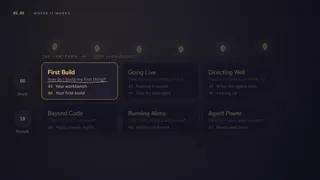
This follows the night the course was rebuilt. That post ended with a draft map and a paused job. The same session installed the map that afternoon, and the job’s first lesson on it is here, whole.
 The point
 The map
 One worker, many rooms
 Pick by the output
 Labels fading
 Across town
 Many doors
 The speaking tube
 At the tube
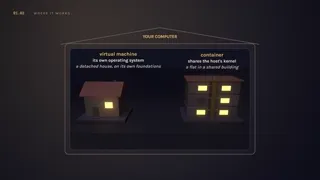 House and flat
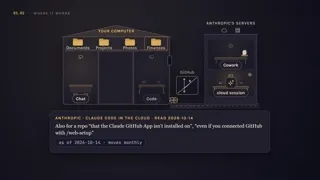 Works on a copy
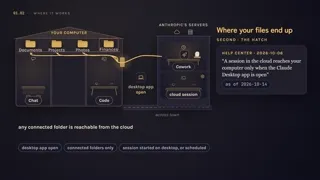 Not on your computer
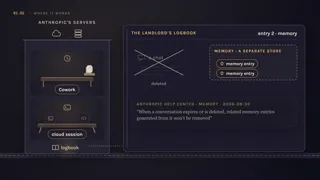 The logbook
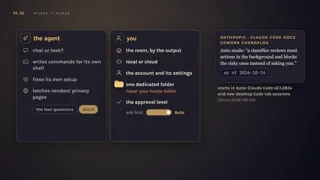 You and the agent
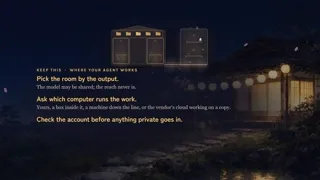 Keep this
How 71 agents split one lesson
The job runs one workflow in ten phases. Five agents read the five sources the narration may name, four more pulled out the points the lesson’s spec asks for, and one went looking for what had changed since the map was written. A planner turned the spec into sections. Three writers drafted the script from three angles at once, and a judge scored them (metaphor-first 85, evidence-first 84, story-first 83, out of 100) and merged the winner with pieces of the other two. Then four fact-checkers and a fixer, a narrator beside a screen-capture agent, a designer, one animator per section, two reviewers for two rounds with a fixer per flagged section, and one agent to render and ship.
| Agent | Phase | Start | End |
|---|---|---|---|
| source:S102 | Sources | 05:37:26 | 05:39:09 |
| source:S184 | Sources | 05:37:28 | 05:39:01 |
| source:S207 | Sources | 05:37:28 | 05:38:51 |
| source:S249 | Sources | 05:37:28 | 05:39:01 |
| source:S209 | Sources | 05:37:28 | 05:39:18 |
| sources:points-2 | Sources | 05:37:28 | 05:38:50 |
| sources:points-1 | Sources | 05:37:28 | 05:43:17 |
| sources:points-4 | Sources | 05:37:28 | 05:38:43 |
| sources:points-3 | Sources | 05:37:28 | 05:38:53 |
| research:now | Sources | 05:37:28 | 05:41:18 |
| planner | Plan | 05:43:17 | 05:47:15 |
| script:story-first | Script | 05:47:16 | 05:54:55 |
| script:metaphor-first | Script | 05:47:17 | 05:56:11 |
| script:evidence-first | Script | 05:47:17 | 05:55:17 |
| judge | Judge | 05:56:11 | 06:03:40 |
| factcheck:sources | Fact-check | 06:03:40 | 06:05:51 |
| factcheck:facts | Fact-check | 06:03:41 | 06:05:45 |
| factcheck:currency | Fact-check | 06:03:41 | 06:04:44 |
| factcheck:beginner | Fact-check | 06:03:41 | 06:05:18 |
| factfix | Fact-check | 06:05:51 | 06:09:29 |
| narrator | Narrate | 06:09:30 | 06:24:47 |
| capture | Narrate | 06:09:30 | 06:20:17 |
| designer | Design | 06:24:47 | 06:35:00 |
| scene:01 | Animate | 06:35:00 | 06:39:37 |
| scene:03 | Animate | 06:35:01 | 06:42:24 |
| scene:05 | Animate | 06:35:01 | 06:39:40 |
| scene:04 | Animate | 06:35:01 | 06:41:13 |
| scene:06 | Animate | 06:35:01 | 06:45:27 |
| scene:07 | Animate | 06:35:01 | 06:48:10 |
| scene:10 | Animate | 06:35:01 | 06:41:45 |
| scene:12 | Animate | 06:35:01 | 06:43:32 |
| scene:09 | Animate | 06:35:01 | 06:43:36 |
| scene:08 | Animate | 06:35:01 | 06:43:41 |
| scene:11 | Animate | 06:35:01 | 06:44:48 |
| scene:15 | Animate | 06:35:01 | 06:38:34 |
| scene:14 | Animate | 06:35:01 | 06:42:32 |
| scene:13 | Animate | 06:35:01 | 06:44:21 |
| review:craft:r1 | Review | 06:48:10 | 06:55:52 |
| review:teaching:r1 | Review | 06:48:11 | 06:55:25 |
| fix:10:r1 | Review | 06:55:52 | 07:00:22 |
| fix:11:r1 | Review | 06:55:53 | 06:58:41 |
| fix:14:r1 | Review | 06:55:53 | 06:57:42 |
| fix:13:r1 | Review | 06:55:53 | 06:59:48 |
| fix:12:r1 | Review | 06:55:53 | 07:01:43 |
| fix:15:r1 | Review | 06:55:53 | 06:58:43 |
| fix:06:r1 | Review | 06:55:53 | 06:59:03 |
| fix:07:r1 | Review | 06:55:53 | 07:05:20 |
| fix:09:r1 | Review | 06:55:53 | 06:58:01 |
| fix:08:r1 | Review | 06:55:53 | 06:59:36 |
| fix:03:r1 | Review | 06:55:53 | 07:02:43 |
| fix:01:r1 | Review | 06:55:53 | 07:04:17 |
| fix:04:r1 | Review | 06:55:53 | 06:59:58 |
| fix:all:r1 | Review | 06:55:53 | 07:16:46 |
| fix:05:r1 | Review | 06:57:42 | 07:00:18 |
| review:craft:r2 | Review | 07:16:47 | 07:23:51 |
| review:teaching:r2 | Review | 07:16:47 | 07:22:50 |
| fix:10:r2 | Review | 07:23:51 | 07:25:30 |
| fix:11:r2 | Review | 07:23:52 | 07:27:20 |
| fix:14:r2 | Review | 07:23:52 | 07:27:00 |
| fix:12:r2 | Review | 07:23:52 | 07:27:11 |
| fix:13:r2 | Review | 07:23:52 | 07:27:45 |
| fix:04:r2 | Review | 07:23:52 | 07:25:22 |
| fix:01:r2 | Review | 07:23:52 | 07:27:53 |
| fix:07:r2 | Review | 07:23:52 | 07:28:21 |
| fix:08:r2 | Review | 07:23:52 | 07:25:02 |
| fix:06:r2 | Review | 07:23:52 | 07:26:44 |
| fix:03:r2 | Review | 07:23:52 | 07:26:56 |
| fix:09:r2 | Review | 07:23:52 | 07:27:46 |
| engine | Review | 07:28:21 | 07:41:18 |
| final-check | Review | 07:41:18 | 07:45:15 |
| ship | Ship | 07:45:15 | 08:17:38 |
The tall blocks are the fan-outs: fourteen animators at 06:35, fifteen fixers from 06:55. The long line at the end is the ship agent, 32 minutes, most of it rendering. It rendered twice, because the publish script refused the first copy: the curriculum had been synced after the render, which changed how section 02 draws the map, so the lesson was rendered again with no new narration.
What the fact-checkers found
Each fact-checker gets the script and one lens. One checks every claim against the source it cites, one checks the facts themselves, one checks whether anything is already out of date, and one reads it as the beginner the course is for. Between them they raised 27 findings, each marked misleading or nitpick. The 17 marked misleading went to a fixer, which applied all of them and “didn’t judge any of them wrong”.
| Checker | Misleading | Nitpick |
|---|---|---|
| Facts | 6 | 5 |
| Beginner | 6 | 1 |
| Sources | 4 | 3 |
| Currency | 1 | 1 |
The sources checker caught the script quoting Ethan Mollick’s advice to use “at least High” thinking as “a high thinking level”, which turns his floor into a ceiling. The currency checker found the billing line saying two ways to pay exist, without the part that catches people: a saved API key, once approved, is billed instead of the plan.
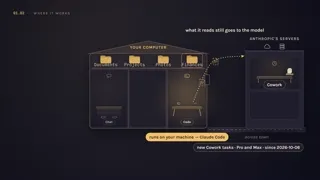
The beginner checker found the two that sit on the lesson’s own question. Section 06 told the viewer that, with Cowork moved to the cloud, Anthropic points local work to Claude Code. Next to section 07’s “Local: your machine, full access”, a beginner hears that Claude Code keeps their files at home. It doesn’t: the commands run on your machine, and whatever it reads goes to the model on Anthropic’s servers.
For local-only work, Anthropic points you to Claude Code.
For work that runs on your own machine, Anthropic points you to Claude Code. Running locally isn't the same as staying local, though: whatever it reads still goes to the model on Anthropic's servers.
For local work, Anthropic points you to Claude Code. Running locally isn't staying local, though: what it reads still goes to Anthropic's servers.
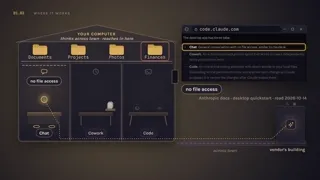
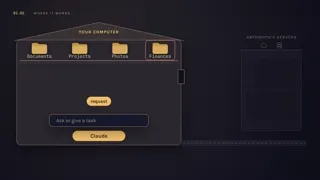
The other was the lesson’s central picture. The script put the model inside your computer, a worker who “can stand in any room”. On every surface in the lesson the model runs in the vendor’s building, so the picture taught the wrong machine in the first minute.
Picture one worker: the model. And your computer as a house of rooms. The worker can stand in any room; what changes is which of your shelves it reaches.
Picture one worker: the model. It always thinks in the vendor's building. And your computer is a house of rooms. The worker can reach any room; what changes is which shelves it can touch.
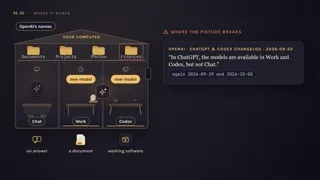
The words were fixed by 06:09. The drawing wasn’t. At the first review, 06:55, the teaching reviewer reported that section 03 still drew the model inside the Chat and Cowork rooms while the narrator says it always thinks in the vendor’s building. The fix reached the script before it reached the picture. It took the review round’s fixers to bring the two together.
What the reviewers found
Two reviewers look at the rendered lesson, one for craft (layout, crops, timing) and one for teaching. The first round’s render ran 733.5 seconds, 12.2 minutes, over the course’s 11.5-minute ceiling.
| Review | Major | Minor | Polish |
|---|---|---|---|
| Craft, round 1 | 5 | 9 | 5 |
| Teaching, round 1 | 4 | 7 | 2 |
| Craft, round 2 | 3 | 13 | 8 |
| Teaching, round 2 | 1 | 8 | 9 |
The second round found more problems than the first, 42 against 32, but fewer major ones, 4 against 9. They were the things you only see once the big ones are gone: a capture zoomed until its text ran off the frame, folder icons sitting on their own labels for about four minutes, a five-row card on screen for two seconds. The script went from 1,608 spoken words to 1,516 and the lesson came in at 11:18. A last agent looked at a still every three seconds, 227 of them, and wrote “ship it”.
What the new map put on screen
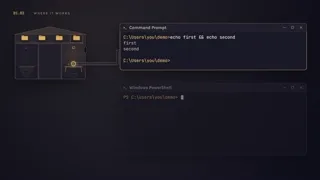
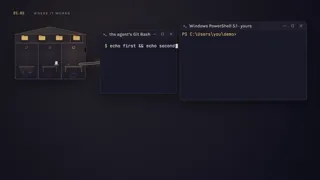
The rebuilt map asks each lesson to show the real thing where it can, so a capture agent recorded screens before anyone animated them: Anthropic’s help page on the 6 October change, the desktop quickstart’s list of environments, and one command run in two shells. Every product fact on screen carries its date and “moves monthly”.
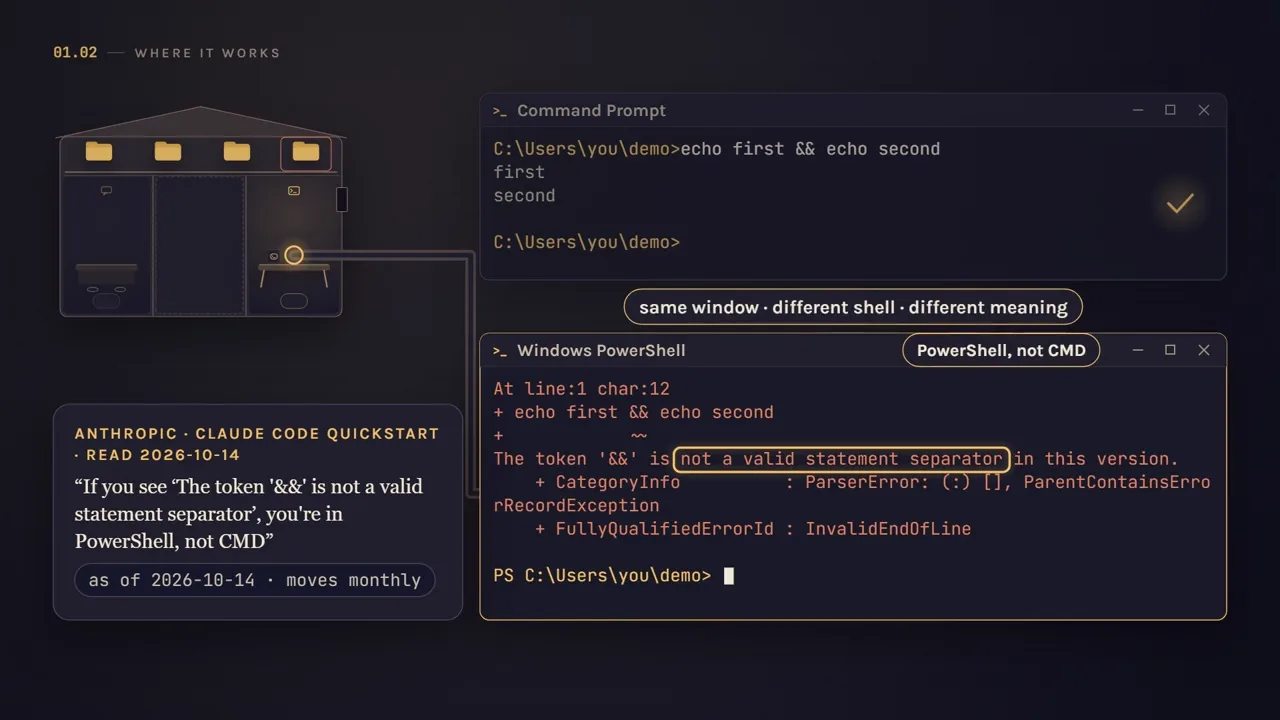
That 6 October change opens the lesson: Pro and Max users who had kept Cowork on their own computer found new tasks running in the cloud, with no way back. It was eight days old when the lesson was made. That morning the research agent checked what had changed since the map was written and filed seven findings for other lessons. One of them carries a date: Anthropic’s Cowork changelog, in a beta entry, says the three-tab desktop app ends on 10 November for organisations that haven’t set one admin setting, so this lesson may need re-recording around then.
A lesson about which computer does the work had to be stopped from naming the wrong computer, and the agent that stopped it was the one asked to know nothing.