A course on the world of my AI-made TV series
I had agents build a companion course for my AI TV series: character sheets, a timeline, a map of its easter eggs and nine narrated lessons, all from one set of files that tags how settled each fact is.
I had four crews of Claude agents spend two days building a companion course for my AI-made TV series, I Love My Evening Television. It has a character sheet for all 77 characters in the series, a timeline, a map of the easter eggs and nine narrated lessons, about 50 minutes in all.
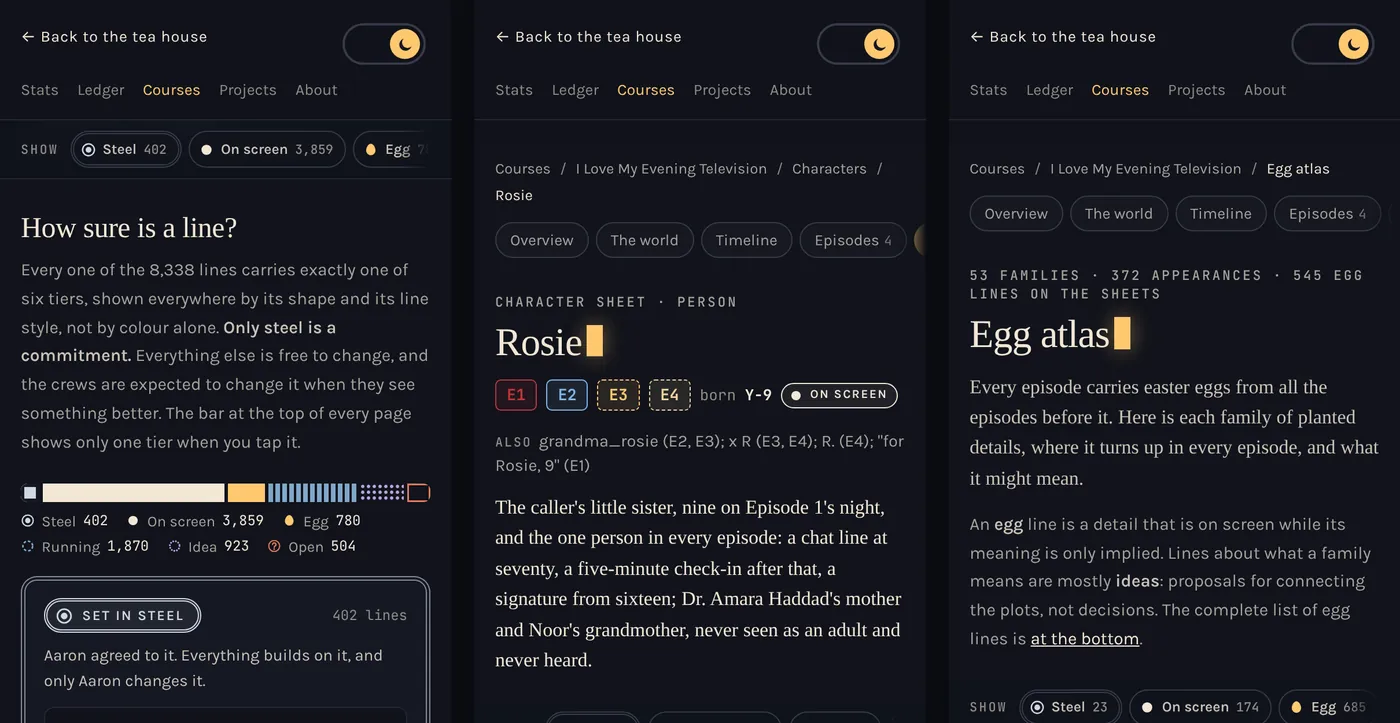
Everything on it comes from one set of plain text files, and every line in them is tagged by how settled it is. Only 402 of the 8,338 lines are “set in steel”, which means I signed off on them. Everything else is free to change.
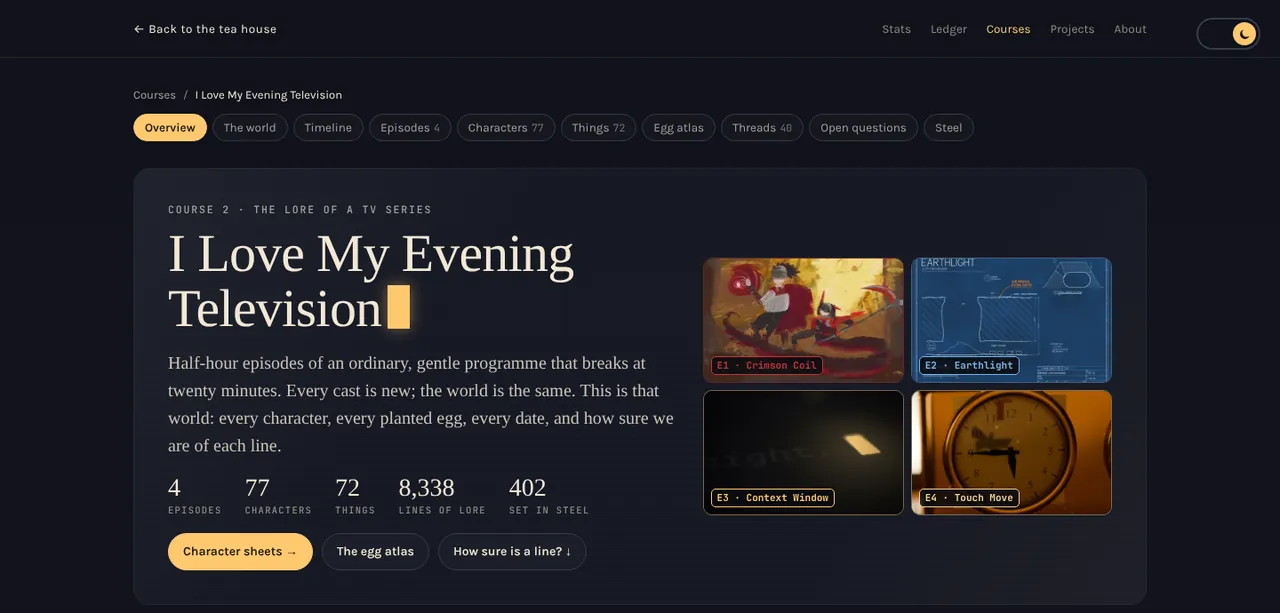
The series is made of half-hour episodes, and there were four when the course went up: Crimson Coil, Earthlight, Context Window and Touch Move. Every cast is new, but they share one world. Rosie is nine in the first episode and about seventy by the time the story reaches the Moon. Details planted in one episode come back in the next, and I call those eggs. All of that was scattered through the crews’ notes. I wanted it in one place, with what I’ve agreed to kept apart from what the agents are only assuming.
What makes it work:
- Every line wears one of six tiers, a tag that runs from set in steel down to open question.
- The lessons draw their own pictures. Code draws them from the lore while a lesson plays, so a new date or picture needs no new recording.
- Every spoken sentence cites its line and has to say how sure it is. A checker refuses any sentence that states a guess as fact.
- It cost about 20,000 voice credits and $3.90 of pictures. The credits are on ElevenLabs (an AI voice service). No GPUs were used (the pricey graphics cards AI usually runs on).
The six tiers
Only steel is a commitment. The rest is there so nobody starts from nothing, and the crews are expected to change it when they see something better.
| Tier | What it means | Lines |
|---|---|---|
| Set in steel | I agreed to it, and only I change it | 402 |
| On screen | Shown, said or written in a finished episode | 3,859 |
| Egg | Planted. The object is on screen, what it means is only implied | 780 |
| Running | The crews’ current reading: notes, inferences, timeline math | 1,870 |
| Idea | A proposal, not adopted | 923 |
| Open | Left unanswered on purpose | 504 |
The steel page is what the agents and I check before building anything.
What’s on the course
- 77 character sheets and
72 things. Every line shows its source, like
{E2 14:07.5}for Episode 2 at 14 minutes 7 seconds. - A timeline of 18 lives, with each person’s age in each episode.
- An egg atlas of 53 families of planted details and what each might mean.
- Threads and open questions.
- All four episodes in full, even the two not on YouTube yet.
The nine lessons
Each lesson is 5 to 6 minutes: the world, one per episode, Rosie’s life, the Moon, threads and eggs, and what’s steel and what’s still a guess. Each has captions, chapters and a transcript you can tap to jump. This is the first one.
The narrator is a voice the agents designed in ElevenLabs and picked in a blind audition. Every recorded line was transcribed back, and the misheard ones were redone. “It is Aaron’s to settle” had come out as “has errands to settle”.
Placeholder pictures
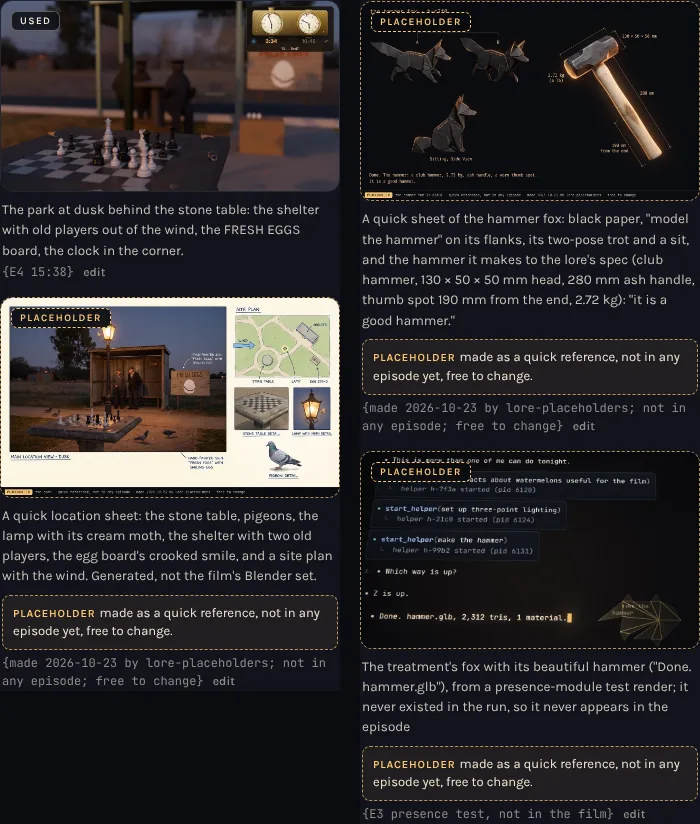
Every picture on the course says what it is. 276 are marked used, mostly frames from the episodes, and 3 are steel, looks I approved. 25 are placeholders, quick references so a character nobody has seen yet still has a face to argue about. Those are free to change, and nobody should copy one into an episode just because it exists.
How it updates
I can change a fact by telling any of my agents (“Rosie is Amara’s mother, set in steel”) or by editing the line. One command rebuilds every page and lesson, and only the sentences whose words changed get voiced again. If a line’s tier moves under a sentence that’s already recorded, the lesson shows a flag like “now Steel (was Open)” until that sentence is rewritten. The first change came that same night. My Touch Move post went live, and its lore lines were updated to say so.
How the narrator was picked
- Fifteen voices read the same passage: six new designs, eight narrators from ElevenLabs’ library and the first design.
- Each reading was transcribed back and measured, and three of Google’s Gemini models ranked them blind.
- The first designed voice came last. It had almost nothing above 3.7 kHz, the high end of the sound, which is why it was muffled on a phone.
- “Tier” was another misheard word. It had come out as “tear”.
What the course holds, in numbers
- 158 lore files, one per character, thing or episode plus the world, the timeline, the eggs, the threads and the open questions. They hold 8,339 lines. One is marked private, so 8,338 are public.
- 153 pages for an episode, character or thing, and every one has at least one picture.
- 421 dated lines on the timeline, where year zero is the night of Episode 1.
- The course shows each tier by its shape, not by color alone.
- 372 egg appearances across the four episodes, in 53 families.
- 40 threads and the open questions, each with the answers on the table.
- Nine lessons of 5 to 6 minutes, each with captions, chapters, a transcript and a 720p MP4.
What it cost
- ElevenLabs: about 20,000 credits. 5,048 went on the audition and 393 on the first prototype. The nine lessons came to about 14,500 with their re-recordings. The quiet music under the lessons was made once with Eleven Music, ElevenLabs’ music maker, and isn’t counted separately.
- Nano Banana Pro, Google’s image model: $3.90 for 19 of the placeholder pictures, 29 takes at $0.134 each. Two more were drawn in code.
- No GPUs. Every lesson was rendered in a web browser running with no screen, on a cloud computer with four ordinary processors.
What wasn't finished when it went up
- No person had listened to the narrator yet, me included. Changing her later means recording all nine lessons again.
- Each lesson’s MP4 download was drawn from the lore as it stood when that lesson was built. The lessons on the page draw today’s lore. The next rebuild re-renders the MP4s.
- The link on each line points into the series’ private code, so for everyone else the source in braces is the record of where a line came from.
Written up from the crews’ own notes. The course, the lessons and the first write-up were by Claude agents.