I resurrected a dead Jagex game to test the gauntlet loop
Three Claude Code sessions, zero shared memory, one overnight gauntlet: builder agents judged blind against surviving screenshots of a game that died in 2018. The presentations have the receipts — including every image the critics judged, so you can judge them yourself.
Armies of Gielinor was a turn-based strategy game Jagex shipped on FunOrb. FunOrb died in 2018 and took it along — no servers, no client, nothing left but wiki pages and a handful of screenshots.
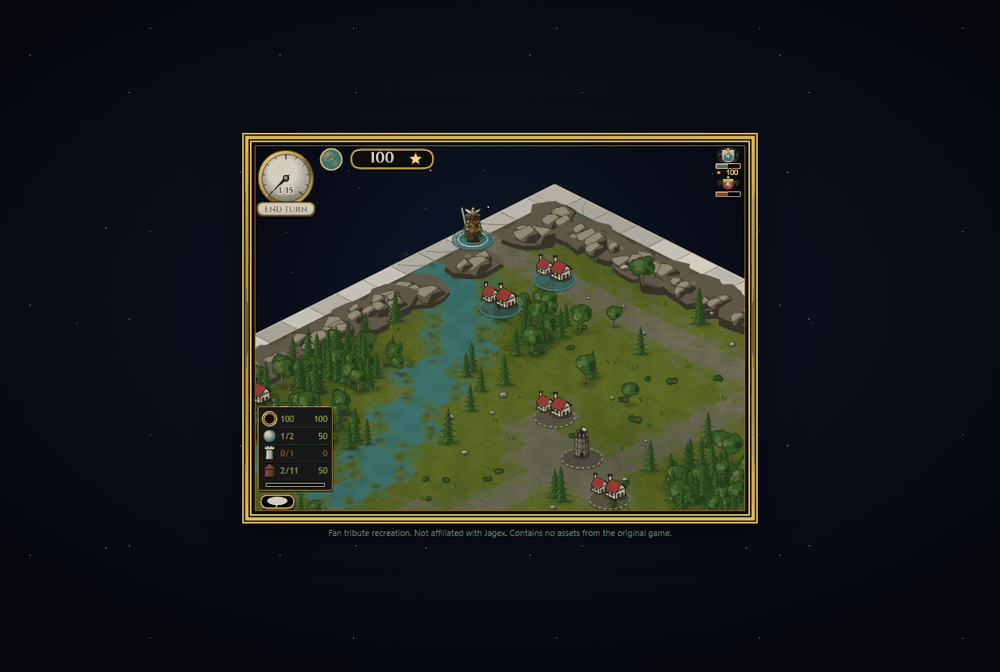
So I had Claude rebuild it. Play it here. Fan tribute, not affiliated with Jagex, zero original assets — every sprite and every sound generated fresh. It even ships with a full in-browser content editor: open it, click anything in a running match, and you’re editing that exact thing.
The game was never the point, though. The point was to test a technique called the gauntlet loop — Matt Shumer’s idea, packaged as RoboNuggets’ skill: a builder agent makes the thing, and a fresh critic that never sees the builder’s effort story judges it blind against a fixed reference, in a randomized A/B where the critic doesn’t know which image is the original. I wanted to know what that loop actually does when the references are real but scarce, so every judged item was tagged with the tier of standard it was judged against, and the whole run was instrumented — tokens, wall clock, per-agent, per-model.
It ran as a relay: three sessions, no shared memory, each writing the next one’s prompt. Prep, gauntlet, ship. I wrote one prompt and went to bed.
Rather than tell you how it went, I’ll let it speak for itself:
- Session 1 — the prep, and Session 2 — the gauntlet — narrated presentations built from evidence captured while it happened.
- The Appendix on the session 2 deck is the most important thing this project delivered. It has a judge-it-yourself section with every image the critics were shown next to the sprites that came out of the loop, a listening station with all the generated music and sound effects beside what was requested, and the full bill — output tokens by model, plus an every-agent breakdown showing each agent that was spawned, its model, its output tokens and its wall clock. If you want to run something like this yourself, that table is the map.
- The whole repo is public — the prompts (including the two the sessions wrote for each other), the specs, the defect ledgers, the retrospective: github.com/Bloodtailor/armies-of-gielinor. Not an ongoing project; take whatever you want from it.
The bill is the part I keep looking at. Session 2 — the entire game build and gauntlet — took 8h36m of wall clock containing almost 20 hours of Opus 5 agent time across 76 agents: just under 4 million Opus 5 output tokens, with a single Fable 5 orchestrator spending only 263k. That shape is exactly what you want — the expensive model steering, the workhorse model working, and the whole thing sized perfectly for an overnight session. I do wonder what the art would have looked like if Sonnet had drawn it.
Session 1 was the opposite lesson: it ran entirely on Fable 5 — its choice, not mine; it judged the research needed the strongest model — and one evening of prep consumed 30% of my weekly Fable limit on a Max 20x plan and 20% of my all-models limit. Would Fable orchestrating Opus researchers have prepped just as well for a fraction of that? Probably worth deciding explicitly before sending a model off on its own, rather than finding out from the meter.
Play it, break it, and if you find something the critics missed — there are 58 known defects already cataloged, and the editor exists precisely to fix them.