Character sheet · Person
Duke Karl II of Brunswick
Alsothe Duke; H. R. H. the Duke of Brunswick; Charles II, Duke of Brunswick (history)
The real Duke who, with Count Isouard, lost the Opera Game to Morphy in his box at the Théâtre-Italien in 1858; in the film a vain living engraving who argues through the opera, and in the box world still claims he said every move.
 Used
 Used
At a glance
- Kind
- Person
- In
- E4 dashed: not released yet
- Lines
- 44
- File
- characters/duke.md
A historical person, in calendar years (not on the Y axis). In Episode 4 the boy plays his side: the teacher makes him "a Duke. ...And a Count." and the boy guesses the Duke's moves before he is told them. When the board becomes the Duke's box in 1858, the Duke is a living engraving, certain the prima donna is looking at him, overruling the Count's better ideas. Their talk is invented, and the teacher says so. In the box world he is still on the stage at the final position, taking the prompter's move as the one he always meant, while the queen sings Edge's account of him not listening.
Who11 lines
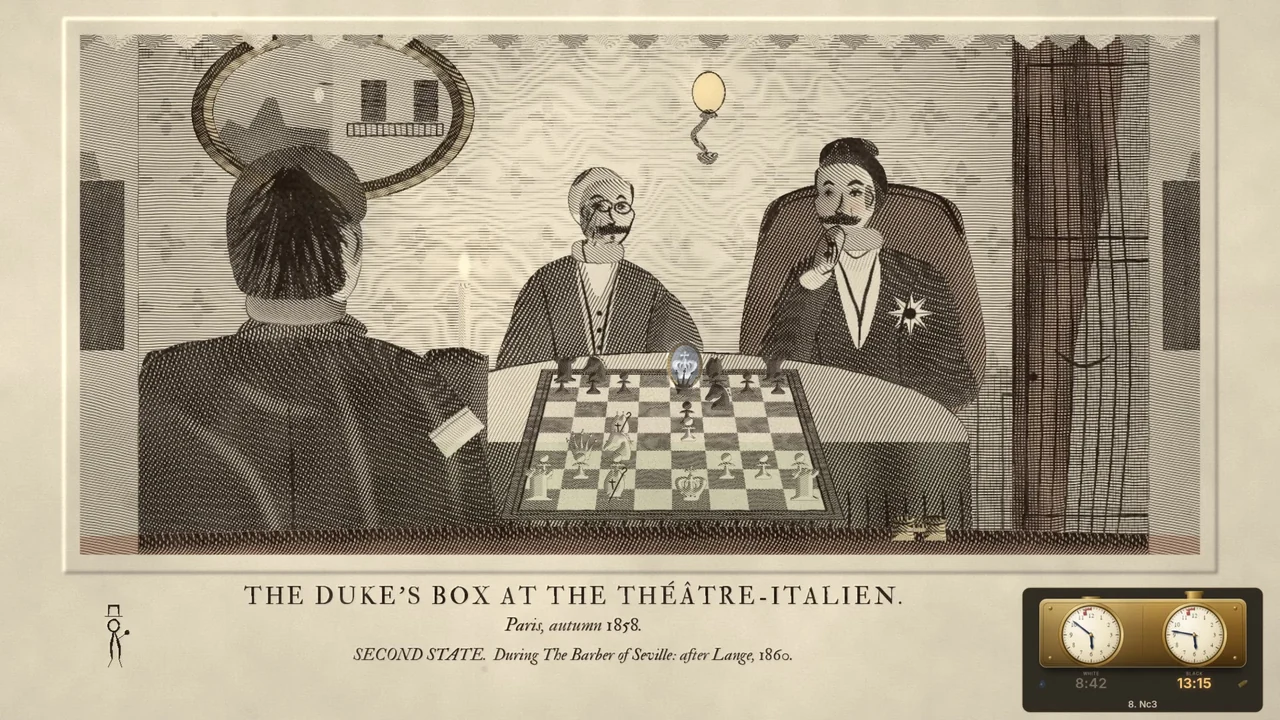
- On screenPlayed Black in consultation with Count Isouard against Morphy: the title sheet's header, Paris, autumn 1858. {E4 0:22-0:29; 1:41} edit
- On screenHis box was right on the stage at the Théâtre-Italien (Edge, read aloud). {E4 7:34.56} edit
- On screen"When the Duke died, his money helped build an opera house." {E4 9:17.57} edit
- On screenEdge, sung: "The Duke, a thorough devotee to Caïssa, had got a chess-board even there, and played throughout the performance." {E4 23:08-23:19} edit
- Running54 in 1858. {E4 MASTER_TREATMENT §2} edit
- RunningHistory left unused on screen: deposed in 1830 when his palace burned; wigs, rouge and diamonds; papers complained of his chess during La traviata in November 1857; his lawsuits. {E4 VOICE_NOTES script-A "unused"} edit
- RunningHistory: he left his fortune to the city of Geneva, which spent part of it on its opera house; the film names no city. {history, not checked by Episode 4's chess-canon crew} edit
- RunningShort, vain and certain; the Count's timid suggestions are the better moves, and the Duke adopts them as his own. {E4 VOICE_NOTES script-A} edit
- RunningCompletely sincere: he believes both things he says. {E4 VOICE_NOTES script-C} edit
- IdeaFor our own reference: a deposed duke who still keeps a box right on the stage; he wants to be looked at, and is sure the singer sings to him. {lore crew 2026-10-22} edit
- IdeaFor our own reference: he plays chess at the opera so that losing looks like boredom. {lore crew 2026-10-22} edit
By episode17 lines
- On screenThe boy plays his side and guesses his moves: e5, Bg4, Nf6, Qe7, b5, Rd8, Qe6 and Nxd7; he misses 2...d6 and 4...Bxf3. {E4 1:49-18:21} edit
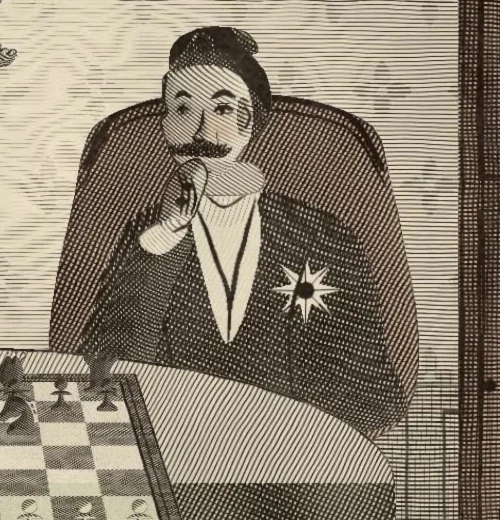
- On screenA living engraving pulled wet from a press: too-black wig, rouge, a dyed moustache, diamonds that glint when he talks, the star of an order. {E4 7:30-8:12} edit
- On screen"She keeps looking at us." The Count: "She is singing, Your Highness." The Duke: "At us." {E4 7:48.40; 7:51.00; 7:53.82} edit
- On screenThe Count: "His knight wants d5." The Duke: "Then pawn c6." {E4 7:54.88; 7:57.69} edit
- On screenNeither he nor the Count notices the stage re-etch from Norma to the Barber. {E4 8:00.79 S08} edit
- On screen"Pawn b5. It attacks his bishop.": the boy's guess, word for word, three seconds earlier. {E4 8:56.35; 8:59.57} edit
- On screenCuts off the Count's "Perhaps, Your Highness... the king—": "The king is perfectly comfortable." {E4 9:03.31; 9:06.52} edit
- On screenThe teacher sides with the Count: "King d8 was better." / "Nobody wrote down what they said." {E4 9:09.49; 9:11.59} edit
- On screenMorphy: "Shh." {E4 9:15.97} edit
- On screenIn the box world his box stands on the stage, lettered H. R. H. THE DUKE OF BRUNSWICK, at the final position. {E4 22:22} edit
- On screenThe prompter: "Queen b4. Check." The Duke: "Queen b4, check. As I have been saying." {E4 22:23.26; 22:25.90} edit
- On screenThe Count: "Your Highness has been saying pawn b5." The Duke: "Both. I have been saying both." {E4 22:31.33; 22:34.56} edit
- On screenSung: "The Duke and Count Isouard, facing him, the game began; they had heard Norma so often, could sing it through without prompting; they did not even listen, disputing with each other as to their next move." {E4 24:02-24:24} edit
- On screenIntercut in the aria, still disputing their next move while the queen sings. {E4 about 24:16-24:26} edit
- On screenThe aria's bridge: the captured crayon pawns as Druids with paper spears march on his box: "Fire and bloodshed against the Roman host, inside the Duke's box!" {E4 24:45.9-24:52.5} edit
- Running"The king is perfectly comfortable." returns among the scramble's overlapping voices. {E4 script S30 fragments_reused} edit
- On screenScramble tile 1: MORPHY v BRUNSWICK & ISOUARD, PARIS, AUTUMN 1858, 17.Rd8# · 1–0. {E4 29:30-29:44} edit
Look3 lines
- On screenA living engraving: too-black wig, rouge, dyed moustache, diamonds and the star of an order. {E4 7:30-8:12} edit
- RunningHis speaking sign: four-point diamond glints that flash when he talks. {E4 MASTER_TREATMENT §2} edit
- On screenThe 1858 box is drawn with Episode 2's Plates kit; opera changes are plate re-bites, not glitches. {E4 7:30; S08; S10} edit
Voice2 lines
Ties6 lines
-
-
-
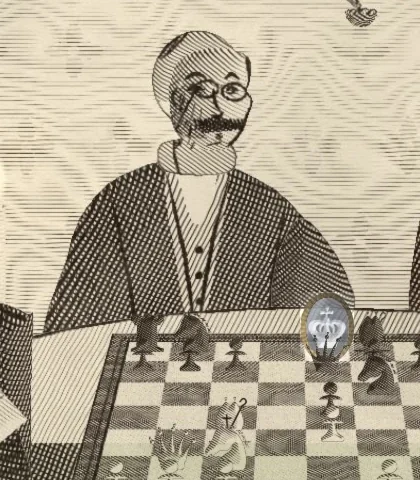
 On screen His Black king is the The daguerreotype king, who asks whether it is his move. {E4 8:02} edit
-
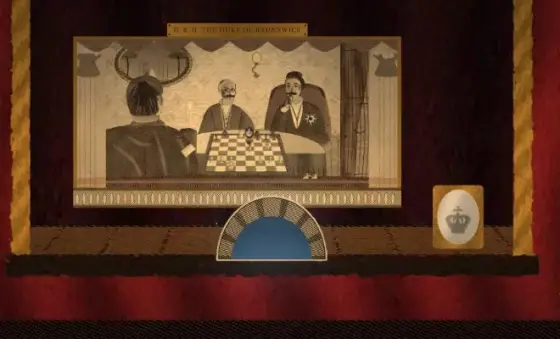 On screen His box stands on the stage of the The opera house of the captured; the The prompter feeds it the move nobody played. {E4 22:22-22:34} edit
-
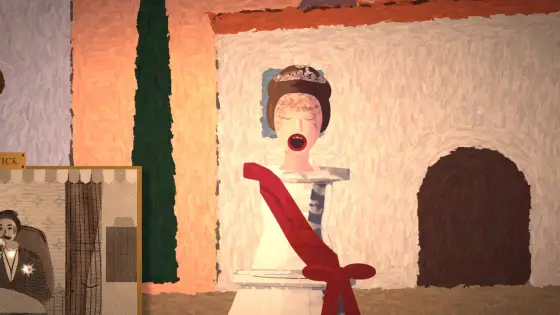
-
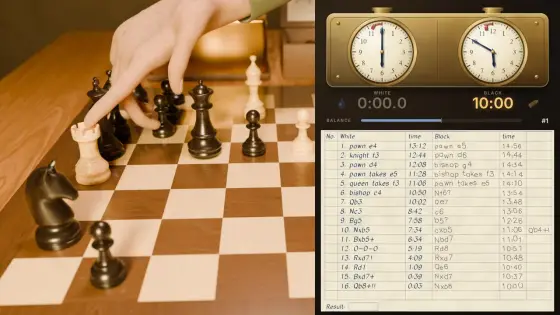 On screen The teacher, the Daniel Fenn, the instructor, tells his story and answers his king. {E4 7:31-9:32} edit
Must stay true2 lines
Open3 lines
- OpenWhich opera was playing that night: Norma (Edge), the Barber (Lange), Cenerentola (Golombek) or Figaro (Fine): "Nobody knows." {E4 9:24-9:32} edit
- OpenWhat the Duke and the Count really said: "Nobody wrote down what they said." {E4 9:11.59} edit
- IdeaHe is still in the box world, still disputing the next move, long after the game is over. {lore crew 2026-10-22} edit